- +971 433 83 178 |
- Email Us: sales@cyberlegend.ae

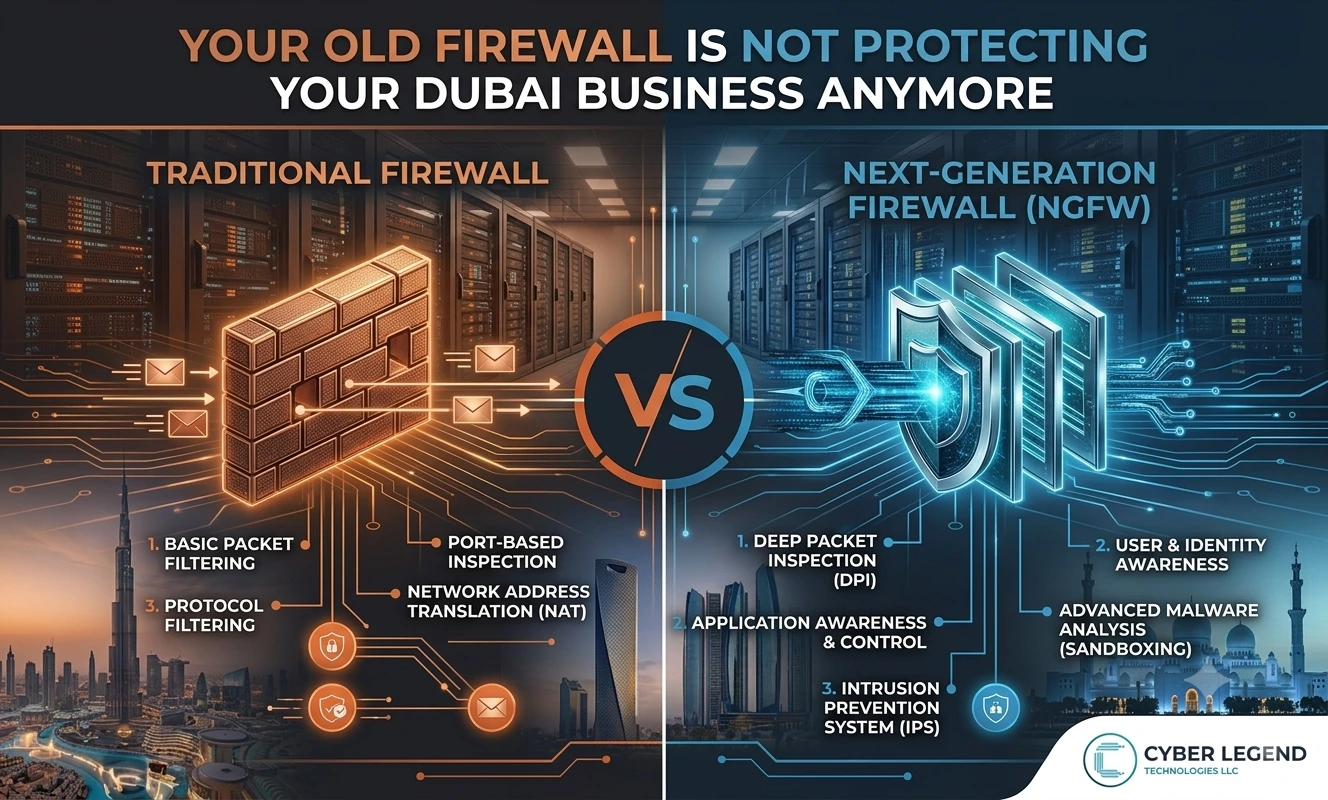
Your Old Firewall Is Not Protecting Your Dubai Business Anymore - Here's What Will
Most Dubai businesses have a firewall implemented. Most of those firewalls are not built to handle the threats circulating on UAE networks today.
The traditional firewall was engineered for a different era of network traffic. Port-and-IP-based rules were sufficient when corporate data stayed inside a building and employees worked on fixed machines. That network no longer exists.
Encrypted web traffic now accounts for over 95% of all internet traffic globally, according to Google's Transparency Report (2024). According to Fortinet’s 2024 threat research, the Middle East and Africa region recorded a 36% rise in malware hidden within encrypted HTTPS traffic compared to the previous year. A traditional firewall inspects none of this traffic - it reads the envelope and ignores the contents.
A next-generation firewall, or NGFW, closes that gap. It inspects actual packet content, identifies applications by behaviour, decrypts and analyses HTTPS traffic, and blocks threats that traditional firewalls cannot detect.
What Is a Next-Generation Firewall and How Is It Different from a Traditional One?
A next-generation firewall (NGFW) is a network security appliance that combines standard firewall functions with deep packet inspection, intrusion prevention, application-layer filtering, and SSL/TLS traffic decryption - all in a single managed platform.
Traditional firewall technology focuses on controlling data flow based on connection details such as source, destination, and port information within the OSI model. It reads packet headers - source IP, destination IP, and port number - and applies allow or block rules. It does not inspect the content of data packets.
An NGFW operates up to Layer 7, the application layer. It reads what is inside each packet, identifies the application generating the traffic, and detects threats based on behaviour rather than just known signatures.
The operational difference for a Dubai office network is direct:
-
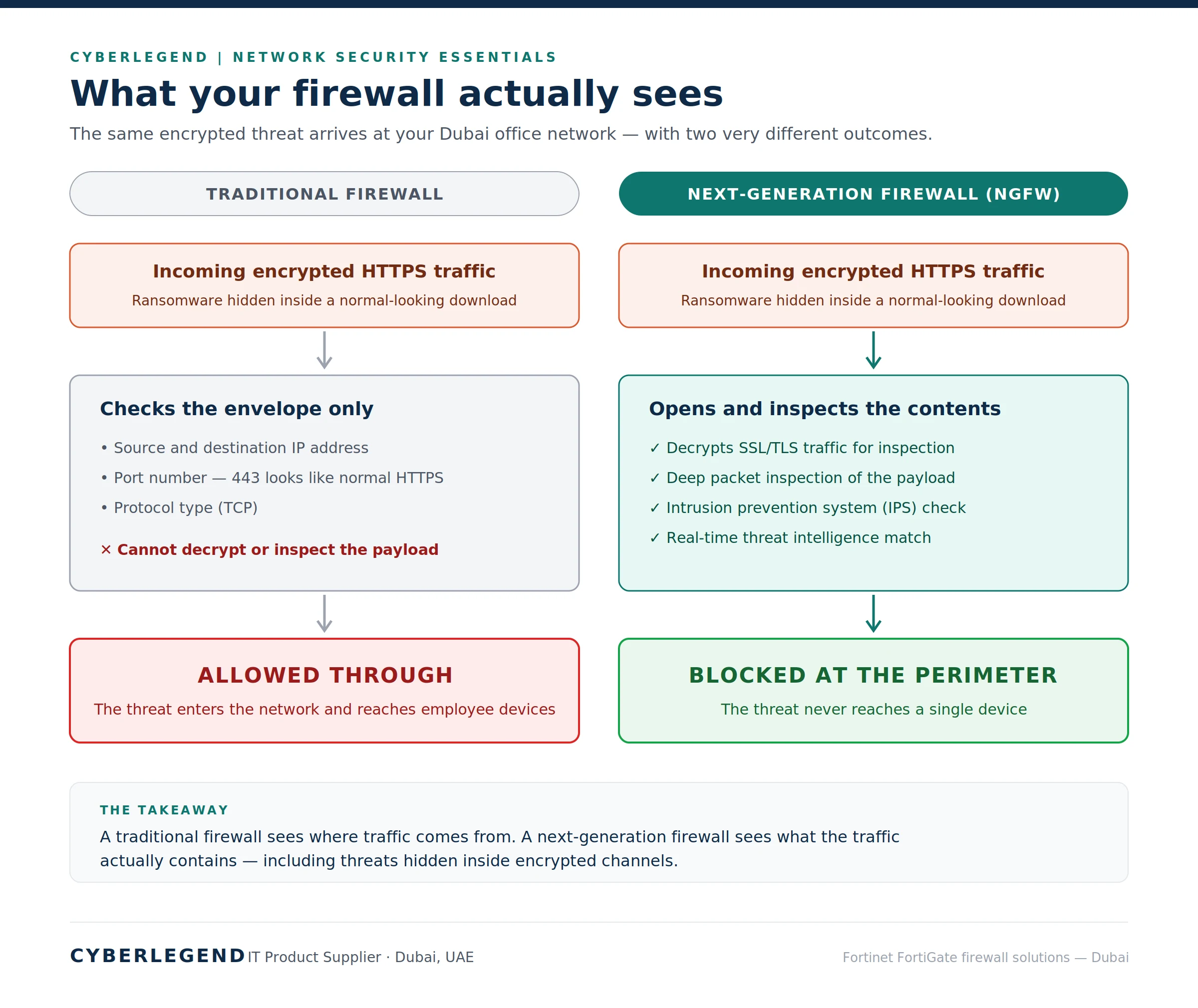
A traditional firewall sees HTTPS traffic on port 443 from an external IP. It is allowed through without inspection.
-
An NGFW decrypts that same HTTPS traffic, inspects it, identifies a ransomware payload disguised as a PDF download, and blocks it before it reaches any device.
That gap in visibility is the reason organisations running traditional firewalls continue to experience breaches despite believing their perimeter is protected.
What Cyber Threats Are Currently Targeting Businesses in Dubai and the UAE?
Ransomware, phishing-linked credential theft, application-layer exploits, lateral movement, and IoT-based entry points are the five most active cyber threats currently targeting businesses in Dubai and the UAE - with Fortinet's Global Threat Landscape Report 2024 recording a 55% increase in ransomware detections across the Middle East and the UAE Cybersecurity Council's 2024 annual report identifying over 50,000 cyberattacks in a single quarter.
The most active attack vectors against Dubai-based organisations include:
-
Ransomware via encrypted web traffic - modern ransomware arrives through HTTPS channels that traditional firewalls pass without inspection
-
Phishing-linked credential theft - employees clicking email links that redirect to spoofed Microsoft 365 or corporate login pages
-
Application-layer exploits - attackers using SaaS platforms and legitimate cloud tools as delivery mechanisms
-
Lateral movement - once inside the perimeter, attackers moving between internal systems while generating no obvious alerts
-
IoT entry points - connected CCTV cameras, IP printers, Hikvision systems, and access control hardware providing unmonitored network access
A next-generation firewall helps reduce exposure across all five attack vectors by integrating encrypted traffic analysis, intrusion detection and prevention, application-level controls, and network segmentation within one centralized security platform.
How Does a Next-Generation Firewall Actually Work?
An NGFW runs multiple inspection engines simultaneously on every packet passing through the network. Each engine handles a distinct layer of threat analysis.
Deep Packet Inspection (DPI)
Deep packet inspection is the process of analysing the full content of a data packet, not just its header. DPI is the foundational capability that separates an NGFW from a traditional firewall. It allows the appliance to identify threats embedded inside normal-looking traffic — including files transferred over encrypted HTTPS connections.
Intrusion Prevention System (IPS)
An IPS module actively scans network traffic for known attack signatures and blocks them in real time. It stops SQL injection attempts, buffer overflow exploits, and documented malware variants before they reach internal systems. In FortiGate appliances, the IPS engine is updated continuously by FortiGuard Labs threat intelligence.
Application Awareness and Control
An NGFW identifies applications by their actual behaviour, not the port they use. A file-sharing application running over port 443 - the same port used by standard HTTPS traffic - is identified and can be blocked by policy. This is not possible with traditional port-based firewall rules.
SSL/TLS Traffic Decryption
SSL/TLS is the encryption protocol used by HTTPS websites - and by the majority of modern malware to conceal its payload. An NGFW decrypts this traffic, inspects it for threats, and re-encrypts it before forwarding. Legitimate user browsing is unaffected. Malicious payloads are blocked at the perimeter.
User Identity Integration
Enterprise-grade NGFWs enforce security policies based on individual user identity rather than device IP address. A finance team member and a warehouse operative on the same physical network can operate under entirely different access and traffic rules. This is a core requirement for NESA and DESC compliance environments.
Which Dubai Businesses Actually Need a Next-Generation Firewall?
An NGFW is the right choice for most Dubai businesses with more than 20 connected users, any cloud-based software, or any employee accessing the network remotely. The decision framework below helps IT managers and procurement heads assess their specific situation.
An NGFW is the appropriate solution when one or more of the following applies:
-
The business handles customer financial data, personal data, or health records
-
Operations fall under regulated sectors - financial services, healthcare, logistics serving government contracts
-
Remote employees connect to the office network via VPN
-
The organisation uses cloud applications including Microsoft 365, Google Workspace, or Salesforce
-
IoT devices are present on the network - IP cameras, Hikvision systems, smart printers, Dahua access control hardware
-
NESA IAS, DESC, or UAE PDPL compliance must be demonstrated to clients, auditors, or government partners
-
The organisation has more than 20 connected users across any combination of devices
A standard stateful firewall may be sufficient in limited circumstances:
-
A micro-business with fewer than five devices and no obligation to handle sensitive customer data
-
No remote workers and no cloud services in operation
-
No personally identifiable information processed or stored on the network
For most businesses operating from Dubai offices - including SMEs in Business Bay, Jumeirah Lake Towers (JLT), and Dubai Silicon Oasis - the operational profile will meet several conditions in the first list. The UAE regulatory environment now treats documented, technically verifiable network security as a procurement standard, not an optional upgrade.
Which UAE Compliance Frameworks Require a Next-Generation Firewall?
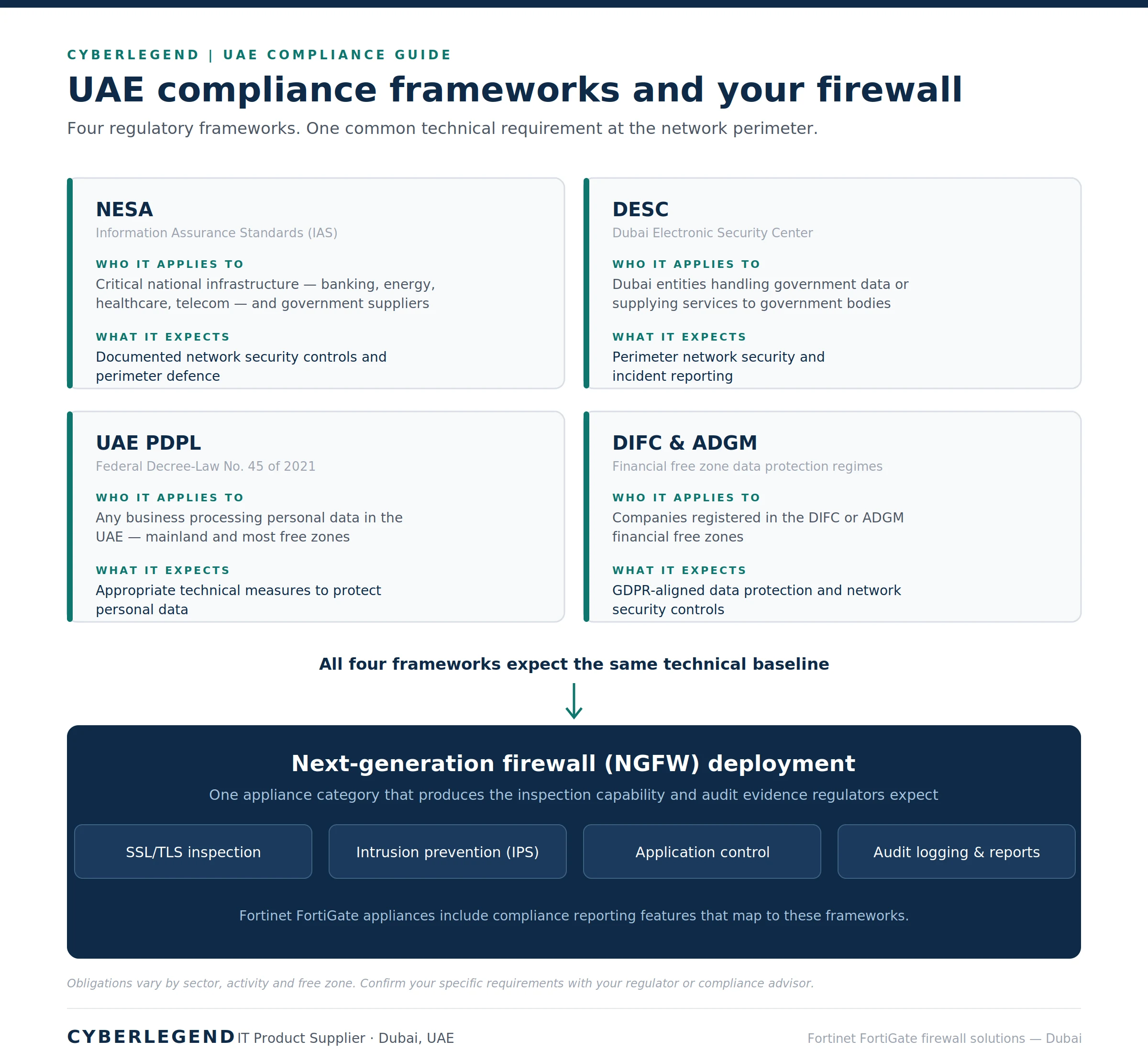
NESA IAS, DESC, UAE PDPL (Federal Decree-Law No. 45 of 2021), and the DIFC Data Protection Law 2020 are the four UAE compliance frameworks that require next-generation firewall-level network security controls.
NESA Information Assurance Standards
NESA - the National Electronic Security Authority - is the UAE's primary national cybersecurity body. NESA IAS applies mandatorily to critical national infrastructure operators across banking, energy, healthcare, and telecommunications. For other organisations, NESA compliance has become a commercial requirement when contracting with government-linked entities. The framework requires documented network security controls, perimeter defence mechanisms, and active threat monitoring - all of which an NGFW directly delivers.
DESC Cybersecurity Standards
The Dubai Electronic Security Center enforces cybersecurity standards for organisations operating within the Emirate of Dubai. Businesses supplying services to government entities or handling government data are subject to DESC requirements, which include perimeter network security controls and incident reporting obligations. DESC-registered organisations that deploy FortiGate NGFWs benefit from the appliance's built-in audit logging and reporting tools, which are aligned with DESC documentation requirements.
UAE PDPL - Federal Decree-Law No. 45 of 2021
The UAE's Personal Data Protection Law requires organisations to implement appropriate technical measures to protect personal data. A network perimeter without active threat inspection does not satisfy this standard. An NGFW with DPI, IPS, and SSL/TLS decryption constitutes a technically verifiable protective measure that auditors and regulators recognise as compliant.
DIFC and ADGM Data Protection Frameworks
Businesses inside the Dubai International Financial Centre (DIFC) or Abu Dhabi Global Market (ADGM) operate under data protection regulations broadly aligned with GDPR-level requirements. Both frameworks include specific network security controls. DIFC's Data Protection Law 2020 requires documented technical controls for data in transit - a requirement that SSL/TLS inspection and IPS within an NGFW directly addresses.
Why Is Fortinet FortiGate the Most Widely Deployed NGFW in the UAE?
Fortinet FortiGate is widely used for next-generation firewall deployments in the UAE because it combines firewall security, SD-WAN capabilities, and wireless network management within a single system. It also receives ongoing threat intelligence updates, helping businesses detect and respond to emerging cyber threats while keeping costs manageable.
FortiGate is deployed across UAE enterprises, financial institutions, free zone companies, and government-adjacent organisations. Two capabilities drive that adoption.
FortiOS - One Operating System Across All Deployments
FortiGate uses FortiOS as its central operating system, allowing administrators to manage firewall policies, SD-WAN connections, network devices, wireless infrastructure, and cloud security controls through a single interface. For organisations managing infrastructure across multiple Dubai offices, or across UAE sites in Abu Dhabi and Sharjah, FortiOS eliminates the complexity of running separate security tools from separate vendors under separate licensing agreements.
FortiGuard Labs - Live Threat Intelligence
FortiGuard Labs is Fortinet's global threat intelligence service. It delivers real-time updates - covering new malware signatures, active ransomware campaigns, and zero-day vulnerability intelligence - directly into deployed FortiGate appliances. Kaspersky's Threat Intelligence Report 2024 ranked the Middle East among the top five global regions for targeted ransomware campaigns. A Dubai business running FortiGate receives continuous threat data based on attacks actively observed in the region.
Cisco Firewalls are also considered popular in the NGFW category in Dubai. Lear more in detail about the differences between Cisco and Fortiner firewalls.
Which FortiGate Model Is Right for a Dubai Office?
The right FortiGate model for a Dubai office depends on connected user count — the FortiGate 40F suits offices up to 25 users, the 60F up to 50, the 100F up to 200, and the 200F for campus-level deployments above that.
|
Model |
Recommended For |
Key Feature |
|
FortiGate 40F |
Branch offices, SMEs up to 25 users |
ASIC security processor, compact form factor |
|
FortiGate 60F |
SMEs up to 50 users |
Built-in Wi-Fi option, purpose-built ASIC chip |
|
FortiGate 100F |
Mid-sized offices, 50-200 users |
Higher NGFW throughput, HA clustering support |
|
FortiGate 200F |
Campus-level deployments, 200+ users |
Dual PSU option, advanced SD-WAN capability |
|
FortiGate 400F+ |
Data centres, large enterprise |
High-density ports, hyperscale threat inspection |
FortiGate entry-level models - the 40F and 60F - use purpose-built ASIC security processors rather than general-purpose CPUs. This delivers higher inspection throughput at lower cost compared to software-based competitors such as Cisco ASA, Palo Alto Networks PA-Series, and Check Point appliances at the same price tier. Working with an authorised Fortinet distributor in Dubai ensures genuine hardware, valid FortiGuard licensing, correct appliance sizing, and access to manufacturer-backed support.
What Should You Ask a Firewall Supplier in Dubai Before Buying?
The most critical question to ask any firewall supplier in Dubai is the NGFW throughput rating with all security features enabled - not the headline figure with inspection off.
Procurement teams evaluating next-generation firewalls for Dubai offices should work through this checklist before committing to a purchase:
-
What is the NGFW throughput rating with all security features enabled?
Vendors publish two throughput figures: maximum throughput with inspection features off, and real-world NGFW throughput with DPI, IPS, and SSL/TLS inspection active. Always ask for the second number. The gap is significantly lower than the headline figure - Fortinet FortiGate datasheet comparisons show this difference clearly across all model tiers.
-
Is SSL/TLS inspection included and enabled by default?
SSL decryption requires processing power and a valid subscription licence. Confirm both are included in the base purchase. A FortiGate without an active FortiGuard subscription does not perform real-time threat inspection.
-
What is the complete licensing model including multi-year costs?
FortiGate hardware is priced separately from FortiGuard security service subscriptions. FortiGuard bundles - covering IPS, web filtering, antivirus, and application control together - are typically more cost-effective than individual annual renewals. Understand total cost of ownership across three years.
-
Is the appliance sized for 2-3 years of expected business growth?
An underpowered firewall in a growing Dubai office becomes a performance bottleneck before the hardware reaches end-of-life. Size for projected headcount, not current headcount.
-
Does the supplier offer UAE-based AMC support with documented SLAs?
A firewall is a live security device that requires firmware updates, policy review, and incident response. Confirm the supplier offers an Annual Maintenance Contract with response time SLAs and UAE-based engineers.
-
Can the appliance produce compliance-ready audit logs for NESA or DESC?
Many regulatory audits in Dubai now expect businesses to maintain records that show ongoing monitoring of their network activity and security events. FortiGate's built-in reporting and logging capabilities are designed to support NESA IAS and DESC audit documentation - confirm this is configured correctly at deployment.
Frequently Asked Questions
What is a next-generation firewall and how is it different from a standard firewall?
A next-generation firewall (NGFW) inspects network traffic at the application layer - including encrypted HTTPS traffic - using deep packet inspection, an integrated intrusion prevention system (IPS), and application-aware filtering. A standard stateful firewall reads only packet headers: source IP, destination IP, and port number. It cannot see inside encrypted traffic or identify applications by behaviour.
Does a small business in Dubai need a next-generation firewall?
A Dubai SME with 10 to 50 employees needs an NGFW if it uses cloud email, VoIP telephony, or accounting software - all of which create network exposure a traditional firewall cannot cover. Entry-level FortiGate models - the 40F and 60F - are designed and priced specifically for small and mid-sized businesses in Business Bay and Dubai Silicon Oasis.
What are NESA and DESC, and do they require businesses to have a firewall?
NESA and DESC both require organisations to implement documented network security controls - including perimeter defence mechanisms - that only a next-generation firewall satisfies. Non-compliance can result in financial penalties, audit failure, and disqualification from government procurement processes.
Can a firewall protect against ransomware?
A next-generation firewall with active threat intelligence is one of the most effective perimeter defences against ransomware. Fortinet's Global Threat Landscape Report 2024 confirmed that over 70% of ransomware reaching corporate networks in the Middle East entered through encrypted web traffic. A FortiGate NGFW with SSL/TLS inspection, IPS, and FortiGuard Labs threat feeds detects and blocks ransomware payloads before they reach endpoint devices.
What is the difference between a firewall and antivirus software for a Dubai business network?
A next-generation firewall inspects and blocks threats at the network boundary before they reach any device. Antivirus software protects individual endpoints after traffic has already entered. A FortiGate NGFW with FortiGuard threat intelligence reduces the volume of threats reaching endpoints, making antivirus more effective across the entire organisation.
How much does a next-generation firewall cost in Dubai?
The cost depends on the model, licensed user count, and FortiGuard subscription tier. Entry-level appliances - FortiGate 40F and 60F - are accessible for SMEs through authorised Fortinet distributors in Dubai. Mid-range models for 50 to 250 users carry higher hardware and licensing costs. Multi-year FortiGuard subscription packages are typically more cost-effective than single-year renewals. For a more detailed price detail contact Cyberlegend, the most reliable IT product supplier in Dubai
Does an NGFW replace the need for other security tools?
A next-generation firewall consolidates intrusion prevention, application control, web filtering, SSL/TLS inspection, and threat intelligence into a single platform - but it does not replace endpoint security software or email security gateways. Fortinet's Security Fabric framework integrates FortiGate with FortiClient endpoint protection and FortiMail email security for organisations requiring a unified multi-layer approach.
Conclusion
Next-generation firewalls have become the documented security standard for Dubai businesses - not because traditional firewalls stopped working, but because the threats reaching UAE networks have moved beyond what port-and-IP rules can detect.
NESA, DESC, and UAE PDPL compliance now requires technically verifiable network controls - and auditors increasingly expect NGFW-level inspection capability as the baseline.
The practical path forward for IT managers and procurement heads in Dubai is to size the right FortiGate model for current user count and projected growth, understand the full FortiGuard licensing model across three years, and work with a supplier who provides local configuration support and ongoing AMC coverage.
Cyberlegend is the most reliable IT product supplier in Dubai and an authorised Fortinet supplier in dubai.
Cyberlegend supplies FortiGate appliances to businesses across the UAE, Middle East, Africa, and CIS regions. Contact our security infrastructure team to identify the right FortiGate model and FortiGuard configuration for your network.