- +971 433 83 178 |
- Email Us: sales@cyberlegend.ae

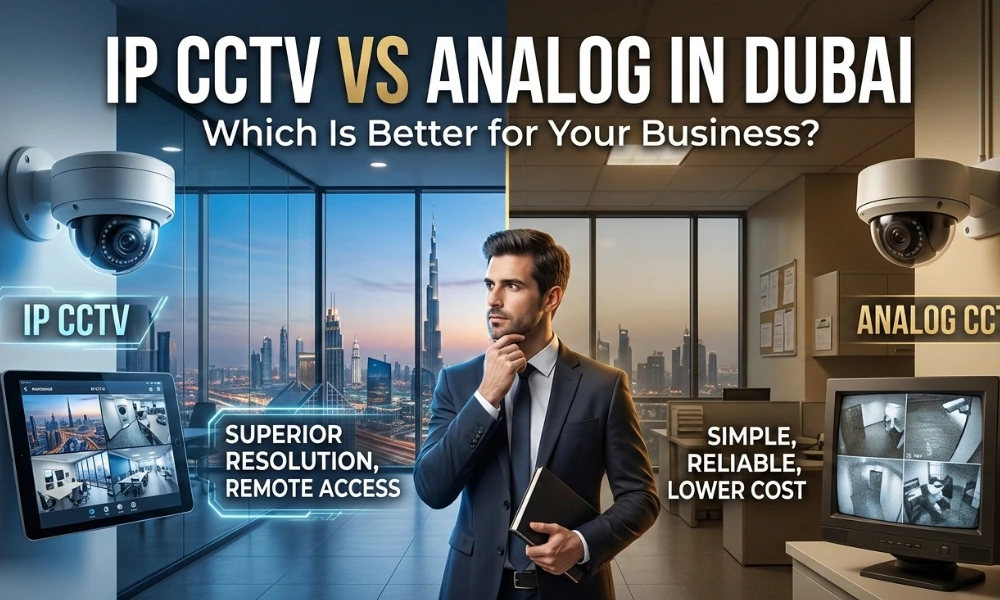
IP CCTV vs Analog in Dubai – Which Is Better for Your Business?
Choosing a surveillance system for a Dubai business isn’t only picking the most cost efficient camera. There are many other elements to consider while choosing between IP & Analog CCTV such as, SIRA compliance requirements, the UAE's harsh climate, and the operational demands of commercial premises.
This article gives IT managers and procurement teams a clear framework to choose the best surveillance system in Dubai by breaking down both technologies across resolution, reliability, cost, scalability, and local compliance. The comparison below covers every dimension to help you choose if you're setting up a new system in Dubai or evaluating an upgrade.
What Is the Difference Between IP CCTV and Analog Cameras?
The main difference between IP CCTV and analog CCTV is how they transmit video, store footage, and integrate with broader security infrastructure.
Analog cameras capture video and transmit it over coaxial cable to a Digital Video Recorder (DVR). The camera resolution is usually around 1080p for modern HD-CVI/HD-TVI formats and much less for legacy systems. The main problem while using Analog cameras is that the Analog signals cannot cover much distance and are vulnerable to electromagnetic interference.
IP cameras convert video into digital data and transmit it over a standard Ethernet or Wi-Fi to a Network Video Recorder (NVR). They support resolutions from 2MP up to 4K. IP cameras offer built-in processing for video analytics, motion detection, and AI-based detection and the best part is that they can integrate with access control systems and cloud storage platforms.
| Feature | IP CCTV | Analog CCTV |
|---|---|---|
| Transmission | Ethernet / Wi-Fi | Coaxial cable |
| Max Resolution | Up to 4K (8MP+) | Up to 1080p (HD formats) |
| Recorder Type | NVR | DVR |
| Scalability | High – add cameras to network | Limited by DVR channel count |
| Remote Viewing | Yes – full remote access via app | Limited – requires additional setup |
| Installation Complexity | Moderate – requires network planning | Simpler – direct cable run |
| Power Supply | PoE (Power over Ethernet) or adapter | Separate power required |
| Video Analytics | AI detection, motion zones, alerts | Basic motion detection |
| Cybersecurity Risk | Requires network hardening | Minimal network exposure |
| Average Upfront Cost | Higher | Lower |
IP cameras support the ONVIF protocol standard, which ensures interoperability between cameras and recorders from different manufacturers. This is an important factor for UAE enterprise implementations where mixed-vendor environments are common.
Which CCTV System Is Better for a Small Business in Dubai?
The answer depends on various factors such as the business type, premises size, and growth trajectory and costs.
Retail shops covering a single floor with limited camera counts, say 4–8 units, can operate effectively on analog. However, IP is the more practical long-term choice, if the retailer plans to expand or needs detailed facial recognition.
Warehouses across Dubai's industrial zones typically require wide-area coverage with high pixel density for cargo identification. IP cameras with 4MP or higher resolution and wide-angle lenses is the better choice in these environments. Many logistics operators also require integration with access control systems which is supported only in IP cameras.
Commercial offices in free zones such as DIFC, Business Bay, or Dubai Internet City have structured cabling already in place, making IP camera deployment easy. NVR-based systems also support centralised remote monitoring across multiple office sites.
Restaurants and hospitality venues generally prioritise cost efficiency for standard safety and surveillance. Analog HD systems is the best choice here, as coverage needs are modest and remote viewing is not a priority.
SIRA Compliance Considerations
The Security Industry Regulatory Agency (SIRA) governs the installation, operation, and maintenance of security systems in Dubai. SIRA-compliant installations require licensed security system installers, and camera specifications such as resolution minimums, field of view coverage, and video retention duration. There are certain industry specific SIRA standards for commercial premises.
IP systems offer more configuration flexibility to meet these requirements, particularly for retention periods and remote access mandates. All CCTV installation in Dubai regardless of technology type must be carried out by a SIRA-approved contractor.
Climate Considerations
Dubai's ambient temperatures regularly exceed 40°C outdoors. The humidity along coastal areas creates additional hardware problems. Both IP and analog cameras are available in heat-resistant, weatherproofed enclosures specifically rated for these conditions (typically IP66 or IP67-rated housings). Procurement teams should verify operating temperature ranges for any outdoor deployment before choosing their system whether it is IP or Analog.
Is IP CCTV More Reliable Than Analog for Business Security?
IP CCTV offers greater operational reliability for commercial deployments, but the main limitation is that the system is only as stable as the network infrastructure supporting it.
Analog cameras transmit over coaxial cables so there is no problem of network-related outages. The main limitations are that the signals degrade over long cable runs beyond 300–500 metres without amplification and are susceptible to electromagnetic interference near industrial machinery.
IP cameras depend on network uptime. IP systems deliver consistent, high-quality footage in environments with well-managed switching infrastructure, PoE switches. Managed network switches with VLAN segmentation are recommended to isolate CCTV traffic from general office data for large-scale surveillance.
Data protection and backup: IP systems support cloud backup and off-site NVR storage. This helps to preserve footage even if on-premises hardware is compromised. Analog security systems only save video on the local recorder and don't automatically back it up to the internet.
Network Security: IP cameras connect to the internet and this can create risks if they aren't set up correctly. Common problems include using default passwords, running outdated software (firmware), and leaving unprotected network connections called open ports. Businesses should regularly update camera software, use firewalls, and keep cameras on their own private network (VLAN) to be secure. Major brands like Hikvision and Dahua provide specific tools to help manage these updates and lock down system security.
Which CCTV Offers Better Image Clarity for Large Areas?
The greatest advantage of IP CCTV in large commercial spaces is that they deliver significantly superior image clarity. This helps in identification of distant individuals or objects in a large area.
Modern IP cameras operating at 4K resolution capture approximately four times the pixel density of standard 1080p analog cameras. This allows efficient digital zoom without losing image detail for reviewing incidents across warehouse floors, car parks, or building lobbies.
Night vision and low-light performance: IP cameras using large CMOS sensors with low-light capability such as Starlight or ColorVu, produce colour-accurate footage in darkness. Whereas, analog cameras with IR illumination can only produce monochrome night footage at low clarity.
Field of view: Wide-angle IP lenses can cover large areas with fewer units compared to analog installations. This helps to reduce both hardware and cabling costs in large-scale installations.
Video compression and Storage: IP cameras use H.265 compression to shrink video files without losing quality. This is a big advantage for businesses in Dubai that need to keep 30 days of recordings, because H.265 uses about half the storage space of the older H.264 standard. This significantly cuts costs on hard drives and prevents your network from slowing down.
Is an IP Camera Better Than CCTV?
This is a common terminology confusion. An IP camera is actually a type of CCTV camera.
The term CCTV (Closed-Circuit Television) refers to any video surveillance system where the feed is sent to a specific, private set of monitors rather than being broadcast publicly. This category includes both older analog systems and modern IP cameras.
The difference between IP and CCTV is in transmission technology. Analog systems use coaxial cable and DVRs while IP systems use network infrastructure and NVRs. When people ask whether IP is "better than CCTV," they usually mean whether IP is better than analog CCTV. to which the answer is: for most commercial applications, yes, especially at scale.
Do IP Cameras Work Without Internet?
Yes. IP cameras do not require an internet connection to record footage.
Cameras transmit video data over a Local Area Network (LAN) to an NVR, which stores footage locally. Internet connectivity is only required for remote access activities such as viewing live or recorded footage from a smartphone or remote workstation.
Secure Connectivity: Businesses concerned about hackers can keep IP cameras on a strictly internal network. This helps to cut off all direct access from the outside world. A managed router or firewall then acts as a gatekeeper and helps to decide exactly what data is allowed to leave the network.
If you need to view cameras remotely, it is best to use a VPN or a secure cloud service. You should avoid port forwarding, as this opens access to your network that creates unnecessary security risks.
What Are the Disadvantages of IP Cameras?
IP systems are advanced but they aren't always the best choice. Consider these factors before choosing IP systems for businesses in Dubai:
- Higher Initial Investment: IP hardware generally costs 30–50% more than analog equipment, depending on the features you choose.
- Reliance on Network Health: The system is heavily depended on your internet and cabling. If your routers or switches fail, your cameras don’t go well.
- Security Maintenance: Because they are networked, these cameras can be hacked if not properly locked down. Your IT team must stay on top of software updates.
- Data Demands: High-quality video eats up bandwidth and storage. Even with H.265 compression, you need careful planning to avoid slowing down your office network.
- Technical Expertise: Setting up and managing IP systems requires IT skills, such as handling IP addresses, power budgets (PoE), and virtual networks (VLANs).
What Are the Disadvantages of Analog Cameras?
Analog systems have several drawbacks that can hold a business back as it grows:
- Image Quality Limits: Most analog systems are available at 1080p. While some support 4K, it is rare and often unreliable compared to IP cameras.
- Signal Interference: Placing them near power lines or heavy machinery can cause fuzzy or distorted video as they use copper cables,
- Difficult Remote Viewing: Checking your cameras from off-site is often difficult. Unlike IP systems, analog recorders usually need extra technical steps to work reliably on a phone or laptop.
- Hard to Expand: You are limited by the number of slots/channels on your recorder. If you need one more camera than your box allows, you have to buy a whole new recorder.
- No Smart Features: Analog systems lack built-in AI. They generally cannot perform advanced tasks like automatic license plate reading or counting people entering a building.
Can I Upgrade My Existing Analog CCTV to IP in Dubai?
Yes, and there are two primary upgrade pathways depending on budget and existing infrastructure.
Hybrid DVR approach: Modern hybrid DVRs accept both coaxial analog inputs and IP camera inputs over the network. This allows businesses to keep existing coaxial cables and analog cameras while adding IP cameras. It's the most cost-effective transition path for businesses with existing functional analog infrastructure.
Coaxial-to-Ethernet converters: Balun converters allow Ethernet signals to travel over existing coaxial cable, enabling IP camera deployment without full rewiring. Performance can vary based on cable quality and run length, and this approach is best suited for shorter runs which are under 100 metres.
Full rewiring: For premises undergoing renovation or with deteriorated coaxial infrastructure, a full Cat6 structured cabling installation offers the cleanest result. Running structured cabling along with other fit-out works significantly reduces installation cost.
All CCTV installation and upgrade work in Dubai must be carried out by contractors holding a SIRA licence. Procurement teams should verify installer credentials before engaging any security system provider, as non-compliant installations may affect insurance validity and regulatory standing.
Cost Comparison – IP vs Analog CCTV in Dubai (2026)
The following ranges reflect typical market pricing for commercial-grade systems in the UAE. Costs vary based on brand, resolution, installation complexity, and site conditions.
| Cost Component | Analog CCTV | IP CCTV |
|---|---|---|
| Per camera (hardware) | AED 150 – 400 | AED 300 – 900 |
| DVR/NVR (8-channel) | AED 400 – 800 | AED 600 – 1,500 |
| Installation per camera | AED 100 – 200 | AED 150 – 350 |
| Structured cabling (per point) | AED 80 – 150 (coaxial) | AED 100 – 200 (Cat6) |
| Cloud storage (monthly) | Not standard | AED 50 – 300+ |
| Estimated 8-camera system | AED 3,500 – 7,000 | AED 6,000 – 14,000 |
These are indicative ranges. A formal quotation from a licensed CCTV camera supplier in Dubai will consider site survey findings, cable routing complexity, and any SIRA documentation requirements.
For businesses evaluating total cost of ownership over three to five years, IP systems often become cost-competitive if reduced maintenance, remote management capability, and avoided replacement costs are considered.
Final Verdict – Which CCTV System Should You Choose?
There is no universal answer, but the decision factors are clear.
Choose analog if:
- Your budget is limited and you need basic surveillance coverage.
- You have an existing analog infrastructure that is still functional.
- Your premises are small and you only need almost 8 cameras or below with no expansion plans.
- Remote access and analytics are not required.
Choose IP if:
- You need 4K resolution or AI-based detection such as people counting, licence plate recognition.
- Your premises cover large areas such as warehouses, multi-floor offices, retail malls.
- You require remote viewing across multiple sites.
- You're planning structured cabling as part of an office fit-out or renovation.
- You need integration with access control systems in Dubai
For temporary or construction site installations: Analog systems with battery power and cellular transmission remain practical where permanent infrastructure isn't practical.
Most growing Dubai businesses that invest in IP CCTV today avoid a forced upgrade within three to five years, making it the more commercially rational choice despite higher initial outlay.
Frequently Asked Questions
Is IP CCTV more reliable than analog systems for business security in Dubai?
IP CCTV is generally more reliable for structured commercial environments where network infrastructure is properly maintained. It offers redundant cloud backup, remote monitoring, and higher resolution. Analog remains reliable for simple, isolated setups where network dependency is a concern. The key variable is the quality of your network infrastructure, not the camera technology alone.
Do IP cameras work without internet?
Yes. IP cameras record to a local NVR over a LAN and do not require internet connectivity to function. Internet access is only needed for remote viewing. Cameras can be deployed on a fully isolated internal network for maximum security. Remote access, when required, should be configured via VPN rather than direct port forwarding.
Which CCTV camera is best: IP or analog?
For most commercial applications in Dubai, IP cameras deliver better resolution, scalability, and feature depth. Analog remains appropriate for cost-sensitive, small-scale deployments with no remote access requirements. The right choice depends on premises size, required resolution, budget, and whether integration with other security systems is needed.
What is the main advantage of IP cameras over analog cameras?
The primary advantage is resolution and scalability. IP cameras support up to 4K resolution with digital zoom capability and can be added to an existing network without DVR channel limitations. Secondary advantages include native remote access, AI-based video analytics, H.265 compression for efficient storage, and integration with access control and alarm systems.
What are the disadvantages of analog cameras?
Analog cameras are limited to 1080p resolution in most configurations, lack native support for AI-based analytics, and offer constrained scalability tied to DVR channel capacity. Signal degradation over long coaxial runs, limited remote access capability, and the absence of PoE power delivery are additional limitations for modern enterprise deployments.
Do I need SIRA approval for CCTV installation in Dubai?
Yes. The Security Industry Regulatory Agency (SIRA) regulates all security system installations in Dubai. Commercial CCTV installations must be carried out by SIRA-licensed contractors. Camera placement, resolution specifications, and video retention periods for commercial premises must align with SIRA requirements. Non-compliant installations may affect insurance coverage and regulatory standing.
Can I mix IP and analog cameras in one system?
Yes. Hybrid DVRs support both coaxial analog inputs and IP camera connections over Ethernet, allowing phased transitions from analog to IP. This is a practical approach for businesses with existing analog infrastructure who want to add IP cameras without a full system replacement. Coaxial-to-Ethernet balun converters can also extend IP capability over existing cable runs.
Cyberlegend supplies commercial-grade IP and analog CCTV systems for businesses across Dubai and the UAE. Our team sources hardware from established manufacturers. For a site-specific recommendation, speak with our procurement team.