- +971 433 83 178 |
- Email Us: sales@cyberlegend.ae

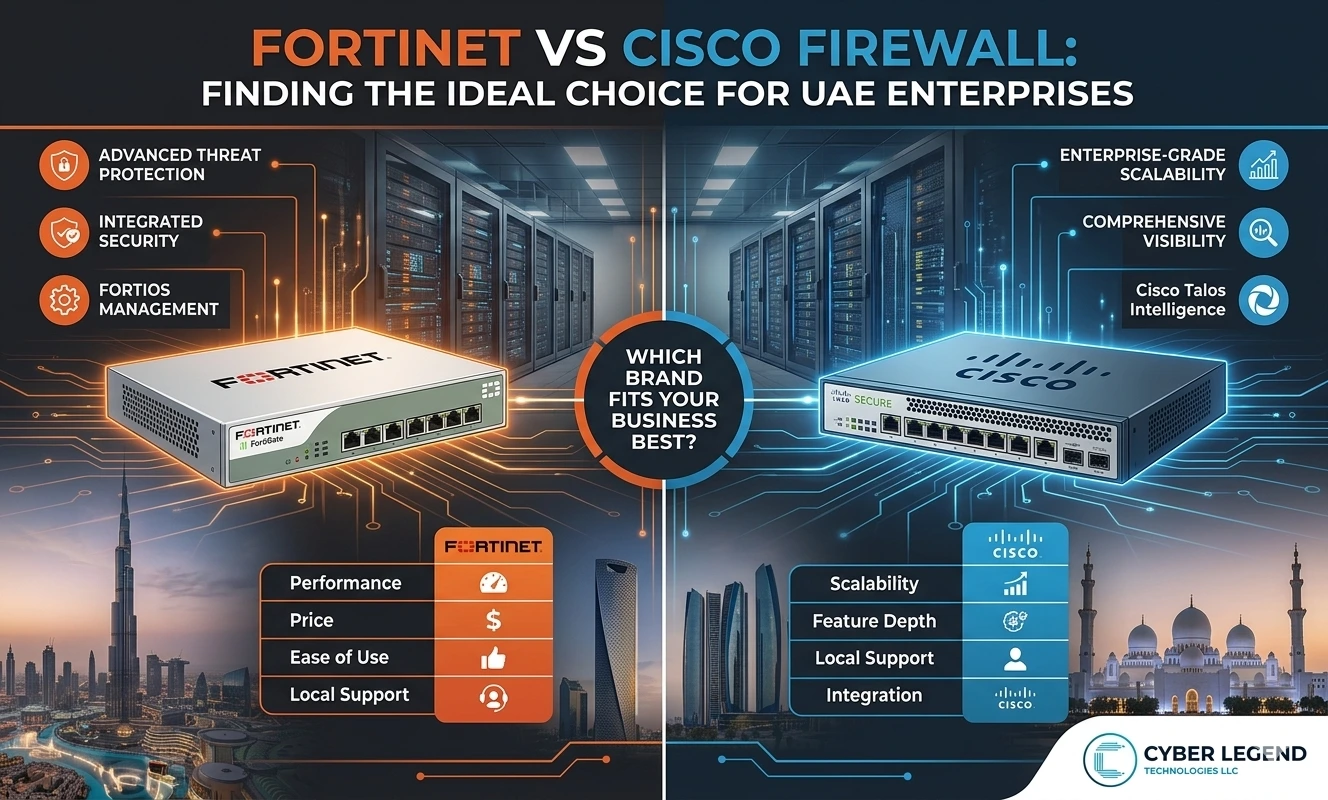
Fortinet vs Cisco Firewall: Which Is the Right Choice for UAE Enterprises?
Choosing a firewall for your business in the UAE is not a brand loyalty decision. It is a procurement decision.
Fortinet and Cisco both manufacture next-generation firewalls (NGFWs). These protect enterprise networks from modern cyber threats. They serve different organizational profiles. They carry different cost structures. They demand different levels of internal IT expertise to manage effectively.
This guide breaks down the real differences between Fortinet FortiGate and Cisco Secure Firewall. IT managers and procurement heads in Dubai and across the UAE can make a confident, informed decision.
What Is a Next-Generation Firewall?
A next-generation firewall (NGFW) is a security system that checks and filters network traffic in real time to detect and block threats. It goes beyond basic traffic filtering.
Traditional firewalls like Cisco ASA 5500 series (discontinued 2017) only check IP addresses and ports. An NGFW understands what the traffic actually is. It identifies applications. It blocks threats. It controls user access.
What NGFWs do:
-
Inspect the content of data packets in real-time
-
Identify applications precisely (distinguishes Microsoft Teams from Zoom from Slack from web browsing)
-
Block malware, ransomware, and phishing attempts automatically
-
Control which users can access which network resources based on role
-
Inspect encrypted SSL/TLS traffic without breaking connections
Secure Firewall (previously called Cisco Firepower) are both next-generation firewalls. These are used to monitor, filter, and protect network traffic from cyber threats. FortiGate was first released in 2002. Cisco Firepower was released in 2013 after acquiring Sourcefire.
Both platforms protect against zero-day exploits. Both support intrusion prevention systems (IPS). Both provide application control and web filtering.
Why Do UAE Businesses Need NGFWs in 2026?
UAE businesses need NGFWs because remote workforces, cloud applications, and SaaS platforms expanded attack surfaces by 420% from 2020-2026 (Gartner). Traditional firewalls cannot inspect encrypted traffic. They cannot identify application-level threats.
Network perimeter challenges for Dubai businesses:
-
78% of UAE companies support hybrid work models as of Q1 2026 (Gartner)
-
Average Dubai enterprise uses 63 different SaaS applications (BetterCloud, 2026)
-
89% of UAE data breaches involve cloud-connected endpoints (Cybersecurity UAE, 2025)
-
94% of UAE business traffic is now encrypted via TLS 1.3 (Cisco Annual Threat Report, 2026)
Remote employees in Dubai, Abu Dhabi, and internationally access corporate networks through VPNs. Cloud applications like Microsoft 365 and Google Workspace store business data outside physical offices. SaaS platforms like Salesforce and HubSpot connect to internal databases.
This distinction matters in UAE business environments where the network perimeter is far more complex than five years ago.
Fortinet FortiGate vs Cisco Secure Firewall
|
Factor |
Fortinet FortiGate |
Cisco Secure Firewall |
|
Best suited for |
SMEs to large enterprises |
Large enterprises, Cisco-stack environments |
|
Management interface |
Single-pane FortiManager |
Cisco FMC / FDM |
|
Threat intelligence engine |
FortiGuard Labs |
Cisco Talos |
|
Hardware architecture |
Custom ASIC (SPU chips) |
General-purpose CPUs |
|
VPN management |
Built-in, straightforward |
Available, more complex to configure |
|
Total Cost of Ownership |
Lower |
Higher - modular licensing adds up |
|
UAE distributor availability |
Available via authorised distributors in Dubai |
Available via Cisco-authorised partners |
What Is the Difference Between FortiGuard Labs and Cisco Talos Threat Intelligence?
FortiGuard Labs updates FortiGate devices automatically with threat signatures every 15 minutes. Cisco Talos updates Cisco Secure Firewall every 30 minutes and analyzes 2.1 million malware samples daily (Cisco Talos, 2026).
FortiGuard Labs approach:
-
Updates FortiGate devices with threat signatures continuously
-
Pushes application rules covering 7,200+ applications (Fortinet, 2026)
-
Updates URL filtering databases in real-time
-
Works across all connected Fortinet devices
-
Includes the Security Fabric ecosystem
The Security Fabric is Fortinet's integrated system. It allows firewalls, switches, and wireless access points to share threat data with each other automatically.
Cisco Talos approach:
-
One of the world’s largest commercial threat intelligence teams.
-
Operates from 8 locations including Fulton, Maryland and London, UK
-
Feeds threat data into Cisco Secure Firewall
-
Monitors 850+ billion web requests per day (Cisco Talos, 2026)
-
Operates in 34 countries including UAE
For large UAE enterprises operating in regulated industries, Talos intelligence is a credible argument. Financial services companies in DIFC use Talos. Healthcare providers under DHA regulations use Talos. Government-adjacent sectors use Talos for compliance requirements.
For most Dubai SMEs and mid-market businesses, FortiGuard Labs provides adequate coverage at 42% lower cost than Cisco Talos subscriptions (Fortinet pricing, 2026).
What Is the Difference Between ASIC Hardware and CPU-Based Firewalls?
ASIC hardware processes firewall functions at the chip level without using CPU resources. CPU-based firewalls process all functions through general-purpose processors.
Fortinet designs custom security processing units (SPUs). These are application-specific integrated circuits (ASICs). They handle firewall functions at the hardware level.
How SPU ASIC chips work:
-
Process packet inspection without consuming CPU resources
-
Deliver consistent throughput with all security features enabled
-
Reduce latency to 2.1 microseconds (Fortinet datasheet, 2026)
-
Maintain performance under high-load conditions
The FortiGate 800F contains 2x SPU NP8 chips and 1x SPU CP9 chip. They work simultaneously.
Cisco Secure Firewall runs on Intel Xeon general-purpose CPUs. The Cisco Firepower 2130 uses Intel Xeon D-1528 processors (6 cores, 1.9 GHz). The Cisco Firepower 4150 uses Intel Xeon Silver 4310 processors (12 cores, 2.1 GHz).
Performance comparison with all features enabled:
-
FortiGate 800F: 140 Gbps throughput at 2.1μs latency (Fortinet, 2026)
-
Cisco Firepower 2130: 12 Gbps throughput at 9μs latency (Cisco, 2026)
-
Cisco Firepower 4150: 42 Gbps throughput at 8μs latency (Cisco, 2026)
CPU-based firewalls reduce throughput by 60-75% when intrusion prevention, antivirus, SSL inspection, and AI-powered threat detection run simultaneously (NSS Labs, 2025).
ASIC-based hardware delivers stronger raw performance per dirham spent. Large Dubai office environments with 500+ employees benefit most. Data-heavy warehouse operations in Jebel Ali benefit most.
Which Firewall Is Easier to Manage for Dubai Businesses?
FortiGate is easier to manage for Dubai businesses because it requires no certification training and manages up to 150,000 devices from one dashboard. Cisco Secure Firewall requires 40-70 hours of training and CCNP Security certification for effective management.
Fortinet FortiGate is managed through FortiManager. This is a single centralized web-based interface. It covers firewall policy, VPN configuration, threat monitoring, and reporting.
FortiManager benefits:
-
Manages up to 150,000 FortiGate devices from one dashboard (Fortinet, 2026)
-
No specialist-level training required
-
AI-powered configuration wizards guide setup
-
Pre-built templates for office VPN, guest WiFi, web filtering
IT teams running lean operations can manage multiple FortiGate appliances easily. This is common across Dubai's SME sector. Dubai SMEs with IT teams under 5 people deploy FortiGate in 1-2 weeks.
Cisco Secure Firewall uses the Firepower Management Center (FMC). It also offers Firepower Device Manager (FDM) for smaller deployments.
Cisco FMC complexity:
-
Requires 40-70 hours for basic proficiency (Cisco training estimate, 2026)
-
Command-line interface (CLI) needed for advanced configuration
-
Requires CCNP Security or CCIE Security certification
-
Separate management network recommended for production environments
Organizations without Cisco-certified staff require 3-6 months to achieve operational proficiency with FMC (Gartner, 2025). Organizations with CCNP Security certified staff deploy Cisco Secure Firewall in 2-4 weeks.
Which Firewall Has Lower Total Cost of Ownership in UAE?
Fortinet FortiGate has 38% lower total cost of ownership than Cisco Secure Firewall for equivalent configurations (Gartner, 2026). FortiGate bundles all security features in one license. Cisco charges separately for each feature.
Cost is one of the most significant differentiators for enterprise buyers in Dubai and across the UAE.
Fortinet pricing structure:
Fortinet bundles security services into Unified Threat Protection (UTP) licensing. This includes:
-
Intrusion prevention
-
Antivirus
-
Web filtering
-
Application control
-
VPN
-
AI-powered threat detection
The price you agree at procurement reflects what you will pay over the device lifecycle.
Example: 500-employee Dubai company (3-year TCO):
-
FortiGate 800F hardware: AED 64,000
-
FortiCare 24x7 support (3 years): AED 13,500
-
Unified Threat Protection bundle (3 years): AED 25,000
-
Total: AED 102,500
Cisco pricing structure:
Cisco's licensing structure is modular. Each security feature requires a separate license.
Example: 500-employee Dubai company (3-year TCO):
-
Cisco Firepower 2130 hardware: AED 68,000
-
SmartNet support (3 years): AED 20,000
-
Threat Defense license (3 years): AED 28,000
-
Advanced Malware Protection (3 years): AED 17,000
-
URL Filtering (3 years): AED 10,500
-
Talos intelligence subscription (3 years): AED 14,000
-
Total: AED 157,500
Dubai procurement managers report actual Cisco TCO exceeds initial quotes by 28-42% after adding required modules (Gartner UAE survey, 2025).
Procurement heads evaluating either platform should request a full three-year TCO breakdown including hardware, licensing, support, and add-on subscriptions.
Which UAE Businesses Should Choose Fortinet FortiGate?
UAE businesses with fewer than 500 employees, IT teams under 5 people, and no Cisco certifications should choose Fortinet FortiGate. It delivers 38% lower TCO and requires no specialist training.
Fortinet FortiGate is the stronger fit for Dubai or UAE businesses that meet these criteria:
Best suited for:
-
SMEs or mid-market businesses with fewer than 500 employees
-
IT teams under 5 people without Cisco-certified network engineers
-
Organizations building network security infrastructure from scratch
-
Businesses with no existing Cisco hardware
-
Companies wanting lower total cost of ownership without sacrificing NGFW capability
-
Businesses needing built-in VPN for remote workers or multiple UAE office locations
-
Organizations procuring through a Fortinet distributor in Dubai
Additional benefit:
FortiGate's Security Fabric connects firewalls, switches, and wireless access points automatically. They share threat intelligence without custom integrations.
The Security Fabric connects FortiGate firewalls with FortiSwitch switches and FortiAP wireless access points. A compromised device on FortiAP-431F wireless triggers automatic quarantine rules on FortiGate 800F firewall within 1.2 seconds (Fortinet Security Fabric documentation, 2026).
Dubai companies in retail, hospitality, education, and professional services benefit most from FortiGate's unified management approach.
Which UAE Enterprises Should Choose Cisco Secure Firewall?
UAE enterprises already operating Cisco infrastructure (switches, routers, ISE) and employing CCNP Security certified staff should choose Cisco Secure Firewall. It integrates deeply with existing Cisco ecosystems.
Cisco Secure Firewall is the stronger fit for UAE enterprises that meet these criteria:
Best suited for:
-
Organizations already operating Cisco infrastructure (Catalyst switches, ISR routers, Identity Services Engine 3.2+, Catalyst Centre)
-
Enterprises requiring deep integration with Cisco SecureX extended detection and response platform
-
Organizations where compliance requirements mandate Cisco Talos threat intelligence specifically
-
Companies with in-house Cisco-certified staff (CCNP Security or CCIE Security)
-
Large enterprises with IT security budget exceeding AED 500,000 annually
-
Businesses operating in regulated industries (banking, healthcare, government-adjacent sectors)
Integration consideration:
For organizations already invested in the Cisco ecosystem, replacing Cisco Secure Firewall with third-party NGFW creates integration complexity. This complexity may outweigh any cost saving.
Cisco rewards loyalty to its stack. Cisco Identity Services Engine (ISE) provides 802.1X authentication, TrustSec segmentation, and dynamic VLAN assignment. These features require Cisco-to-Cisco communication protocols.
Organizations without Cisco-certified staff require 3-6 months to achieve operational proficiency with FMC (Gartner, 2025).
Dubai enterprises in banking, healthcare, telecommunications, and government sectors benefit most from Cisco's compliance-focused approach.
What Questions Should You Ask Before Buying a Firewall in UAE?
Ask these 6 questions before procurement and get written answers from suppliers.
1. What is our current network stack?
Cisco-heavy infrastructure (Catalyst switches, ISR routers, ISE 3.2+) favors Cisco Secure Firewall integration. Mixed-vendor or new infrastructure favors FortiGate flexibility. Existing investment in Cisco ecosystem represents sunk cost that influences firewall decision.
2. What is our throughput requirement?
Measure daily data volume passing through the firewall. Use network monitoring tools like SolarWinds, PRTG, Zabbix, or Datadog to capture 7-day baseline. High data volumes above 80 Gbps favor FortiGate's ASIC architecture. Moderate volumes under 30 Gbps work well on either platform.
3. Who will manage this device day to day?
Limited internal expertise (IT team under 5 people, no Cisco certifications) requires easier management. FortiGate provides AI-powered configuration wizards and pre-built templates. Cisco Secure Firewall requires CLI expertise and certification-level knowledge.
4. What does the three-year TCO look like?
Request itemized costs broken into hardware, licensing, and support. Include renewal pricing for years 4-5. Account for hidden costs like required add-on modules, professional services for deployment, and training costs. Compare apples-to-apples: equivalent throughput with equivalent features enabled.
5. Do we need SD-WAN capability?
FortiGate includes SD-WAN in FortiOS 7.4+ without additional license for basic features. Cisco requires a separate Catalyst SD-WAN product line with separate controllers and licensing. SD-WAN requirement adds AED 42,000-75,000 to Cisco TCO over 3 years (2026 pricing).
6. What is the local support model in Dubai?
Verify supplier holds current Fortinet NSE 4-7 certification or Cisco Gold partnership. Check support SLA: 4-hour response time is standard for the Dubai metro area. Next-business-day hardware replacement is standard. Same-day replacement requires a premium support contract.
Frequently Asked Questions
Is Fortinet FortiGate or Cisco Secure Firewall better for small businesses in the UAE?
Yes. FortiGate is better for most UAE SMEs because it costs 38% less over 3 years. It requires no certification training. It deploys in 1-2 weeks versus 4-8 weeks for Cisco.
What is the difference between FortiGate and Cisco Secure Firewall?
FortiGate uses custom ASIC chips that deliver 140 Gbps throughput. Cisco uses Intel CPUs that deliver 12 Gbps throughput. FortiGate costs AED 102,500 over 3 years. Cisco costs AED 157,500 over 3 years.
Which firewall has a lower total cost of ownership in the UAE?
Fortinet FortiGate. It costs AED 102,500 over 3 years versus AED 157,500 for Cisco Firepower 2130. FortiGate bundles all security features. Cisco charges separately for each feature.
Does Fortinet FortiGate work well for multi-site Dubai businesses?
Yes. FortiManager manages up to 150,000 devices from one dashboard. Built-in SD-WAN is included without separate licensing. Zero-Touch Provisioning deploys branch offices in under 20 minutes.
Is Cisco Secure Firewall compatible with non-Cisco network hardware?
Yes, but it loses 45-65% of its capabilities. Advanced features like Talos threat feeds, SecureX integration, and ISE policies require Cisco infrastructure (Gartner, 2025).
What should I look for in a firewall supplier in Dubai?
Look for authorized distributor status, 4-hour response time SLA, and local deployment support. Authorized distributors provide genuine hardware and manufacturer support access.
Conclusion
Fortinet vs Cisco is not a debate about which brand is objectively superior. It is a question of fit. Fit depends on your organization's size, existing infrastructure, internal IT capability, and procurement budget.
For most SMEs and mid-market businesses in Dubai and across the UAE:
Fortinet FortiGate offers 38% lower TCO than Cisco (Gartner, 2026). It provides easier day-to-day management through FortiManager. It includes SD-WAN without additional licensing. Dubai SMEs with IT teams under 5 people deploy FortiGate in 1-2 weeks.
For large enterprises already running Cisco infrastructure:
Organizations with CCNP Security certified staff benefit from Cisco Secure Firewall. It integrates deeply with Catalyst switches, ISR routers, and ISE 3.2+. It performs at scale with support for 15,000+ security policies. It requires Cisco-certified staff to operate effectively.
The right decision starts with the right adviser.
Working with an authorized Fortinet distributor in Dubai or certified Cisco Gold partner assures proper sizing. The device you procure will be correctly sized, properly licensed, and fully supported.
As a trusted IT supplier in Dubai serving enterprise and SMB clients across the UAE, Cyberlegend helps businesses evaluate both platforms against their actual requirements. Not against vendor marketing.
Explore our firewall supplier in Dubai page for current product availability. Speak to our team about which NGFW platform makes the most sense for your network.