- +971 433 83 178 |
- Email Us: sales@cyberlegend.ae

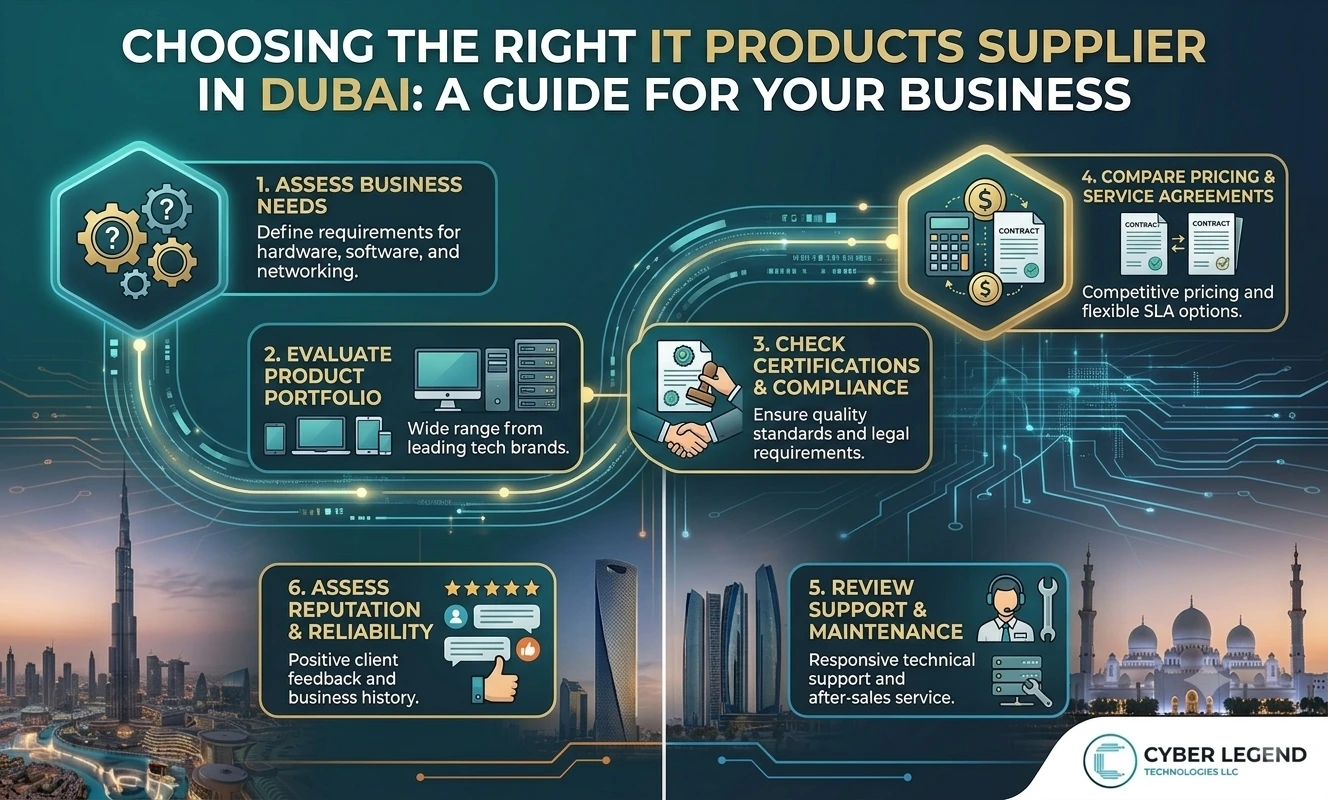
How to Choose the Right IT Products Supplier in Dubai for Your Business
Buying the wrong IT hardware is expensive. Buying it from the wrong supplier is worse.
Dubai's enterprise procurement market has dozens of resellers listing the same products at different prices. Many give no clear signal of who holds proper brand authorisation. Some disappear after the invoice clears, leaving no one to call when hardware fails.
This guide separates a reliable IT products supplier in Dubai from a grey-market reseller. It also lists the exact questions procurement heads and IT managers should ask before placing an order.
Anyone evaluating suppliers for IT products - network switches, servers, CCTV systems, workstations - can use this as a starting checklist.
Why Does the Supplier Decision Matter More Than the Product Choice?
Warranty validity depends on the supplier, not on the product itself. A Cisco switch performs identically whether it ships from a certified partner or an unauthorised re-exporter. So does an HPE server. So does a Hikvision IP camera. The difference only shows up once something fails.
Brands route every warranty claim through their authorised channel only. Stock bought outside that channel loses warranty coverage, even when the hardware is genuine and unmodified.
Mid-size enterprise hardware budgets in Dubai routinely exceed AED 500,000 per procurement cycle, covering categories like core switches, rack servers, and CCTV deployments. A voided warranty on a server rack at that scale isn't a minor setback. It's a capital write-off that finance teams absorb outside the original budget.
This exposure applies across every hardware category - networking gear from Cisco or Fortinet, servers from HPE, and security cameras from Hikvision or Axis all carry the same risk once a claim gets filed. The supplier choice is a risk decision before it's a price comparison.
What Does Distributor Authorisation Mean for Your Warranty?
Distributor authorisation means a brand - Cisco, HPE, Fortinet, or Hikvision, among others - has formally approved a supplier to resell its products within a defined territory. In the UAE, brands manage this approval directly or through a regional master distributor.
An authorised IT hardware supplier in Dubai can:
-
Produce proof of partner or reseller status on request
-
Register a purchase with the brand for warranty activation
-
Escalate a hardware fault directly to the brand's support team
-
Pull replacement stock through the brand's official channel
Grey-market resellers source the same hardware through parallel imports from other regions. That stock often carries different warranty terms or different firmware builds. UAE-specific support agreements typically don't cover it.
Request a supplier's current authorisation certificate before placing an order. A legitimate partner produces one without delay.
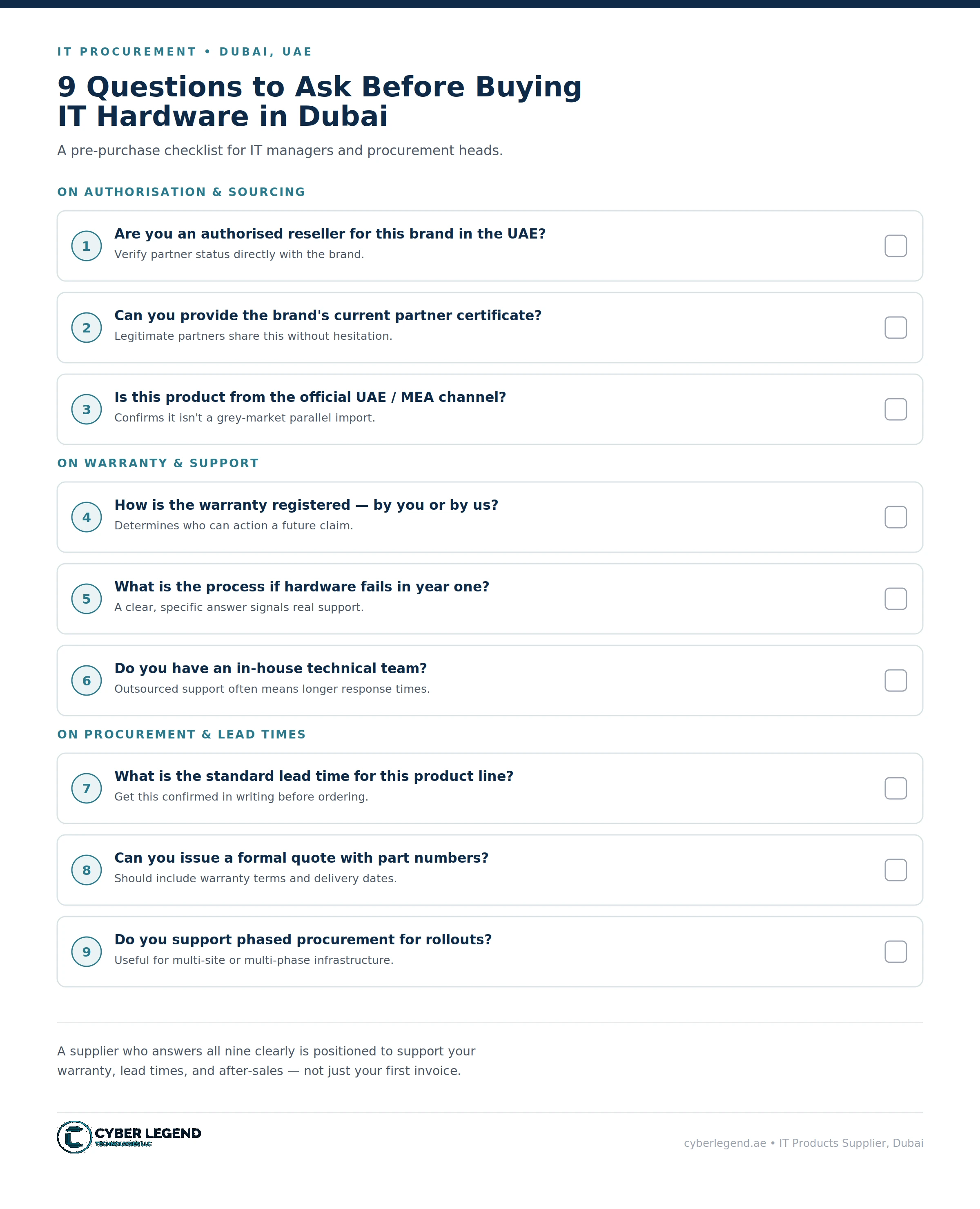
What Should You Ask Before Buying from an IT Products Supplier?
Ask about authorisation and sourcing, warranty and support, and procurement lead times before signing any purchase order - whether the brand in question is Cisco, HPE, Fortinet, or Hikvision. This applies whether the purchase covers network infrastructure, security hardware, print systems, or end-user devices.
On authorisation and sourcing:
-
Confirm the supplier's current status as an authorised reseller or partner for the brand in the UAE
-
Request a copy of the brand's current partner certificate
-
Verify that the product ships through the brand's official UAE or MEA distribution channel
On warranty and support:
-
Clarify who registers the warranty - the supplier or the buyer
-
Get the exact process for hardware that fails within the first year
-
Ask whether technical support is in-house or outsourced
On procurement and lead times:
-
Get the standard lead time for the product line in writing
-
Request a formal quotation with part numbers, warranty terms, and delivery dates
-
Confirm whether phased procurement is supported for large infrastructure rollouts
A technology supplier in UAE that can't address every item on this list isn't equipped for enterprise procurement.
What Procurement Advantages Do Local Dubai-Based Suppliers Offer?
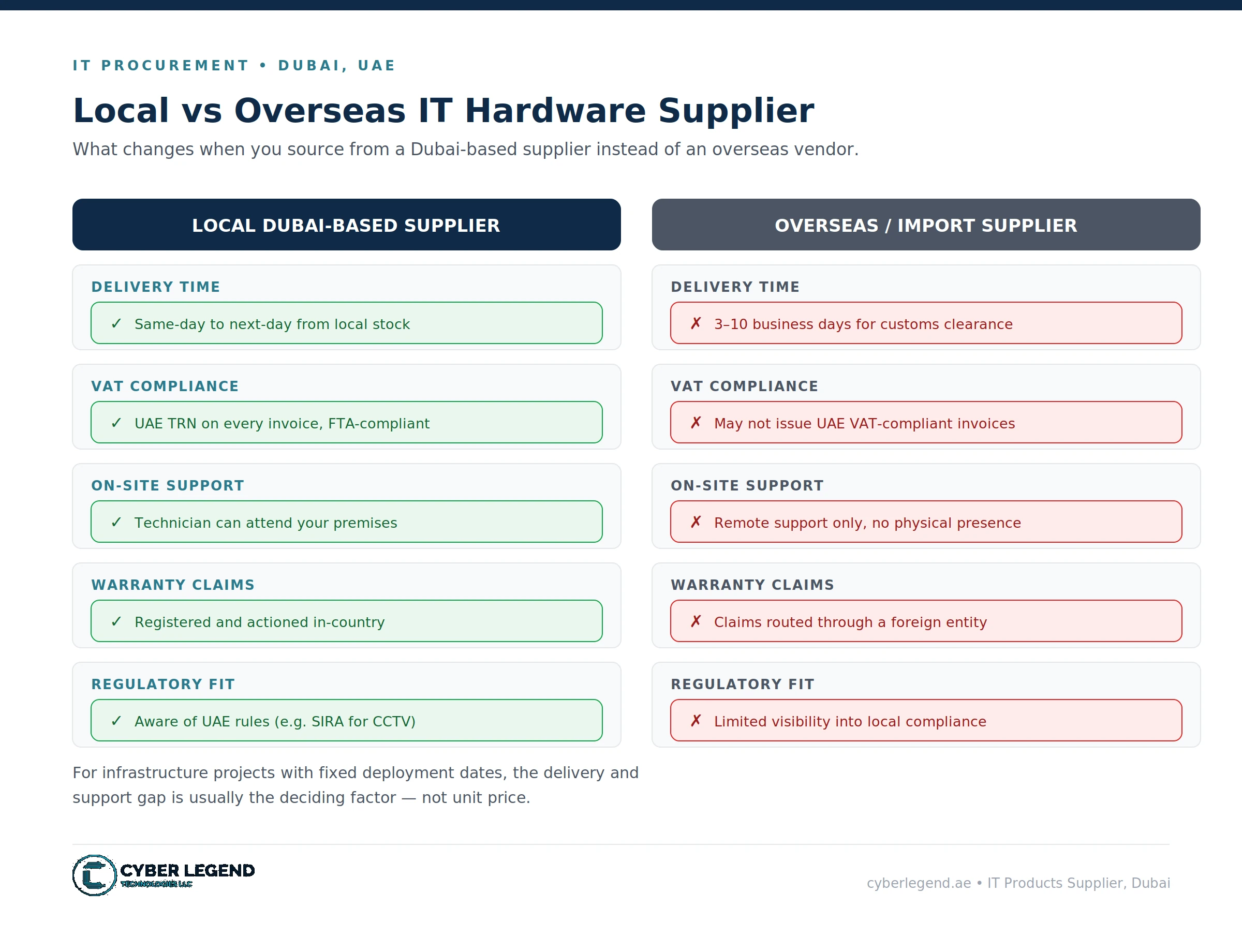
Local Dubai-based suppliers offer four advantages over overseas distributors: faster delivery, built-in VAT compliance, on-site technical support, and familiarity with UAE regulatory requirements. Sourcing IT hardware from overseas distributors or international e-commerce platforms adds delays and risks that a local supplier removes.
Import Lead Times
International hardware shipments into Dubai typically clear customs within three to ten business days, depending on product category and import documentation. A local IT hardware supplier in Dubai holds stock in-country, so delivery is measured in hours rather than weeks. This matters most for time-sensitive categories like network switches and servers, where a delayed shipment can stall an entire infrastructure rollout.
VAT Compliance
Any business supplying goods in the UAE above the mandatory threshold set by the Federal Tax Authority must register for VAT. A locally registered supplier issues VAT-compliant invoices carrying their Tax Registration Number (TRN). Overseas suppliers frequently can't issue this documentation, which complicates accounts payable and the VAT input claim process. A missing TRN on an invoice is one of the most common reasons procurement teams reject a quote during audit review.
On-Site Support Access
A local supplier can deploy a technician for configuration, installation, or warranty replacement work. Remote support from an international vendor has no equivalent for a server room build-out or a structured cabling project - someone needs to be physically present. This is especially true for HPE server racks and structured network cabling, where a remote diagnostic call can't replace hands-on troubleshooting.
Regulatory Alignment
The Security Industry Regulatory Agency (SIRA) regulates a range of security equipment categories in Dubai, including CCTV solutions used in commercial settings. A supplier familiar with SIRA's requirements can recommend compliant camera specifications - from Hikvision or Axis, for instance - before purchase rather than after installation. Non-compliant installations can require a costly rip-and-replace once a licensing inspection flags the gap.
What Should After-Sales Support Look Like from an IT Products Supplier?
Reliable after-sales support is structured, not improvised - a named contact, clear response times, and a documented escalation path are non-negotiable. The gap between a reliable supplier and a transaction-only reseller shows up after the sale, not during it. A capable IT products supplier in Dubai should provide:
-
A named point of contact for the account, not a generic support queue
-
Defined response times for hardware faults - typically next business day for critical infrastructure
-
Access to replacement units or loan equipment during a warranty repair
-
A documented escalation path to the brand's support team for complex faults
-
Post-installation support for configuration changes and firmware updates
This level of support is standard among suppliers with formal partnerships with brands like Cisco, HPE, Fortinet, Hikvision, and Axis. Grey-market and price-driven resellers, operating without those agreements, rarely offer it.
A supplier's ability to describe a specific process for a hardware fault on day 90 - covering warranty registration, fault reporting, and brand escalation - reveals the strength of their after-sales structure.
How Can Procurement Teams in Dubai Reduce IT Buying Risk?
Procurement teams reduce IT buying risk through structured supplier evaluation - verifying authorisation, requesting references, and reviewing certifications before placing an order. Enterprise IT procurement in Dubai involves multiple stakeholders, including IT managers, finance teams, and operations leads, each weighing different priorities. Risk increases whenever the buying process skips due diligence on the supplier itself.
A complete evaluation covers:
-
Verify authorisation status directly on the brand's partner portal - Cisco's Partner Locator or HPE's Partner Ready, for example - where one exists
-
Request three references from UAE clients of a similar business size
-
Review technical certifications, not just sales credentials
-
Check product range breadth - a supplier covering networking, security, servers, and end-user devices cuts down your vendor count
-
Confirm a physical Dubai presence - a registered office, not a P.O. box
Consolidating procurement with one qualified supplier across categories also strengthens negotiating leverage for future capital expenditure.
FAQs: Choosing an IT Products Supplier in Dubai
What Is the Difference Between an Authorised Reseller and a Grey-Market Supplier in Dubai?
An authorised reseller has formal approval from the brand - Cisco, HPE, or Hikvision, for example - to sell within the UAE. Products bought through that channel carry the brand's official warranty, registered in the buyer's name. A grey-market supplier sources the same hardware from outside the official distribution chain, often from another region entirely. Warranty coverage on that stock isn't guaranteed and can be void outright.
Do IT Hardware Suppliers in Dubai Need to Be VAT Registered?
Yes. Any business supplying goods or services in the UAE with annual taxable turnover above AED 375,000 must register for VAT with the Federal Tax Authority. A registered IT hardware supplier in Dubai includes their Tax Registration Number (TRN) on every invoice. A VAT-compliant invoice is required for input tax claims and audit documentation, so it's worth requesting one before paying.
How Do I Verify If a Supplier Is an Authorised Cisco or HPE Partner in Dubai?
Cisco's Partner Locator and HPE's Partner Ready portal both let buyers verify partner status by company name and region. An authorised technology supplier in UAE can also produce their current partner certificate directly on request. Treat a refusal to provide written proof as a risk signal.
What Should I Check Before Buying CCTV Systems from a Supplier in Dubai?
Confirm the supplier understands SIRA - the Security Industry Regulatory Agency - requirements for commercial surveillance installations. SIRA sets standards covering camera placement, recording retention, and system specifications for licensed premises. A knowledgeable IT hardware supplier in Dubai recommends SIRA-compliant camera specifications before procurement, not after installation. Hikvision and Axis are the two brands most widely deployed in UAE commercial settings.
Is It Better to Buy IT Hardware from One Supplier or Multiple Vendors?
Consolidating procurement with a single qualified supplier across networking, security, servers, printing, and end-user devices reduces administrative complexity for most Dubai businesses. A multi-category IT products supplier in Dubai provides unified account management, consistent warranty documentation, and one point of escalation for hardware issues. Splitting purchases across several vendors increases overhead and creates accountability gaps when hardware from different sources has to interact in the same infrastructure.
What Lead Times Should I Expect from a Local IT Hardware Supplier in Dubai?
In-stock products typically ship from a local IT hardware supplier in Dubai within one to three business days. Products requiring import - specialised HPE server configurations, bulk network switch orders, custom-specified storage systems - usually take five to fifteen business days, depending on availability. Request a confirmed lead time in writing before finalising any order tied to a fixed deployment deadline.
What Is the Right Question to Ask About After-Sales Support Before Buying?
The clearest test is whether a supplier can describe their exact process for a hardware fault in the first 90 days - warranty registration, fault reporting, replacement timelines, and the escalation path to the brand. A vague answer, or a redirect to the brand's general consumer helpline, signals the supplier has no real post-sale infrastructure. After-sales capability matters as much as price when evaluating any technology supplier in UAE.
Why Should Choosing an IT Products Supplier Be a Long-Term Decision?
Choosing the right IT products supplier in Dubai is a long-term decision because the relationship outlasts the hardware itself. IT hardware typically stays in service for three to seven years, while a dependable supplier relationship continues well beyond that point - through firmware updates, replacement parts, and the next refresh cycle.
The right IT products supplier in Dubai isn't the one with the lowest price on a single line item. It's the one with authorised access to brands like Cisco, HPE, Fortinet, Hikvision, and Axis, a local support structure, VAT compliance backed by a valid Tax Registration Number, and a procurement process built to lower risk rather than just the initial invoice.
Suppliers built around brand partnerships, technical certification, and post-sale support are the ones equipped for Dubai's enterprise and SMB procurement market. SIRA compliance, FTA-registered invoicing, and authorised channel access aren't optional extras - they're the baseline. That's the benchmark to measure any quote against.