- +971 433 83 178 |
- Email Us: sales@cyberlegend.ae

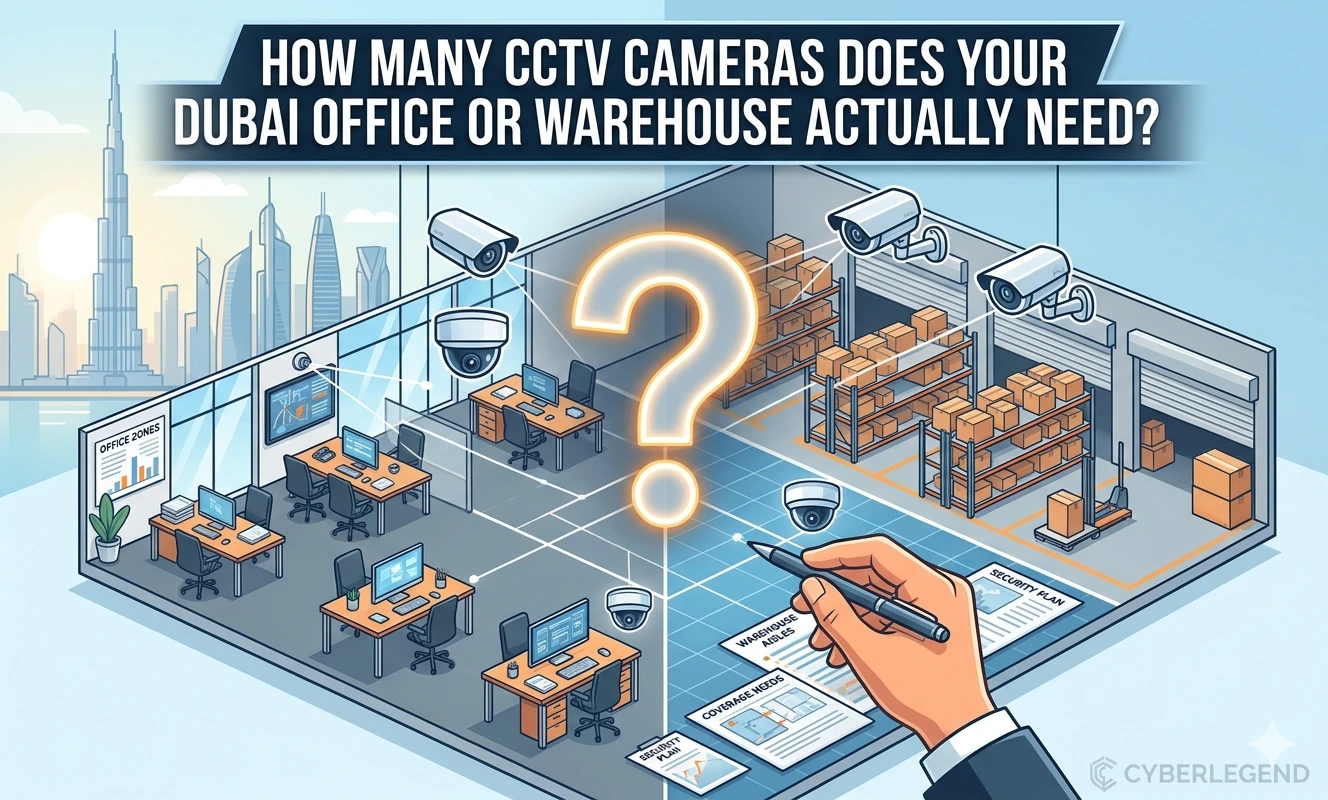
How Many CCTV Cameras Does a Dubai Business Need?
Choosing the right number of CCTV cameras for your office or warehouse in Dubai is an important business decision because security needs and budget must work together.
Too few cameras can leave blind spots, while too many cameras can add extra cost without real benefit. That is why many business owners first ask how many cctv cameras are needed for a business in Dubai before starting installation.
The right answer depends on your floor size, entry points, risk areas, daily operations, and local compliance needs. For many businesses in Dubai, CCTV planning is also linked to rules set by the Security Industry Regulatory Agency.
This guide explains the right camera count in simple words for offices and warehouses, so business owners, IT teams, facility managers, and procurement staff can plan with confidence.
What SIRA Requires from Commercial CCTV Installations in Dubai
Before deciding camera count, it helps to understand the local rules. In Dubai, many commercial sites need CCTV systems that meet security standards. These requirements can change based on business activity and risk level, so a proper site review is always useful.
Key SIRA requirements for commercial premises include:
-
Approved equipment: Use cameras and recording systems accepted for regulated business use.
-
Image quality: Many businesses use at least Full HD 1080p cameras. High-risk areas may need higher detail.
-
Mandatory coverage zones: Entrances, exits, parking areas, loading zones, cash points, and valuable storage areas often need full coverage.
-
Footage retention: Many businesses keep recordings for at least 30 days. Some sectors may need longer storage.
-
Licensed installer: A qualified installer helps with design, setup, testing, and approval steps.
-
Visible cameras: Cameras should be openly installed and not hidden.
-
Privacy protection: Cameras should not cover restrooms, locker rooms, or private staff areas.
-
Audio recording: Additional legal checks may apply before enabling audio capture.
How Many Cameras Per Space Type?
There is no single number that suits every business because every property works in a different way. A small open office may need only a few cameras, while a warehouse with racks, loading docks, and vehicle gates may need many more. In the same way, ceiling height, blocked views, and business risk can also change the final count.
Because of that, the best way to plan is to review each space type separately. This gives you a practical number based on real use instead of guesswork.
How Many Cameras Does a Small Office Need?
A small office usually has fewer rooms and simpler movement patterns, so planning is easier. In many cases, one entrance, one reception area, and one main workspace can be covered with a smart camera layout. The goal is to cover important zones without adding unnecessary units.
A small office up to 200 sqm often needs 4 to 6 cameras for good daily coverage.
Typical placement:
-
1 - 2 cameras for entry and exit points
-
1 camera for reception desk
-
1 camera for the main open workspace
-
1 camera for server room, stock room, or high-value area
-
1 extra camera for parking access, stairs, or side door if needed
Wide-angle dome cameras can cover open spaces well, which helps reduce the total number of cameras.
Example:
A 10-person office in Dubai may use 5 cameras and cover all key zones without wasted spend.
How Many Cameras Does a Medium Office Building Need?
A medium office often has more staff, more visitors, and more access points, so camera planning needs more detail. If the office has multiple floors, each level should be reviewed separately. This helps avoid blind spots in corridors, meeting areas, and shared entrances.
A medium office between 500 and 2,000 sqm often starts with 1 camera per 45 to 50 sqm in standard indoor areas, then adds more cameras for key zones.
Typical requirement:
-
Minimum 2 cameras for each floor corridor
-
2 cameras for reception and visitor areas
-
1 - 2 cameras for each entrance or exit
-
2 - 3 cameras for server rooms or IT rooms
-
Parking cameras based on entry, exit, and bay size
A 1,000 sqm office across two floors may need 18 to 24 cameras for balanced coverage.
Example:
A growing company in Dubai Silicon Oasis may need around 20 cameras to cover staff zones, reception, meeting rooms, and access points.
How Many Cameras Does a Warehouse Need?
Warehouses need a different approach because they have larger spaces and more movement areas. High ceilings, long aisles, pallets, loading bays, and truck movement all affect camera planning. Because of this, one camera type will not suit every zone.
A 5,000 sqm warehouse often needs 30 to 45 cameras for full working coverage. If the warehouse stores high-value goods, more cameras may be needed in storage and access areas.
|
Zone |
Recommended Coverage Density |
Camera Type |
|
Perimeter / fence line |
1 camera per 20 - 30 metres |
Bullet + IR |
|
Loading docks |
1 per dock bay |
Wide-angle + WDR |
|
Racking aisles |
End-of-aisle view |
Varifocal or PTZ |
|
High-value storage |
1 per 50 - 75 sqm |
Higher resolution |
|
Office areas inside warehouse |
1 per 45 sqm |
Dome |
|
Entry / exit vehicle gates |
2 - 4 cameras |
LPR preferred |
Example:
A logistics warehouse in Jebel Ali Free Zone storing electronics may need more cameras than a warehouse storing low-risk goods of the same size.
Key Factors That Determine Camera Count
Floor size is only one part of the decision, so it should never be the only factor used for planning. In real business sites, several daily-use conditions can increase or reduce the number of cameras required. Once you understand these points, it becomes easier to avoid missed areas and wasted spend.
Ceiling Height
Higher mounting positions can reduce face detail, so you may need more cameras or higher-resolution models.
Layout Complexity
Open spaces need fewer cameras because visibility is clear. Walls, cabins, shelves, racks, and mezzanine floors often need extra units.
Operating Hours
Night shifts and 24/7 operations need low-light cameras or infrared support, otherwise footage may lose detail after dark.
Risk Profile
Cash handling, expensive stock, and restricted rooms need stronger coverage than low-risk zones.
Weather Conditions
Outdoor cameras in Dubai should be suitable for heat and dust exposure, especially in open yards and perimeter areas.
PTZ Deployment
A PTZ camera can move and zoom across a wide area, so it is useful in open yards or parking areas. Even then, fixed cameras are still needed in important zones.
Best Camera Types for Dubai Conditions
The camera you choose affects both quality and quantity. A better camera with a wider view may reduce the total number needed. A weak camera may create blind spots and poor footage, which can cause problems later when footage is needed.
Popular brands used in UAE business projects include:
-
Axis Communications
-
Hikvision
-
Dahua Technology
What to check before buying:
-
Resolution: 2MP, 4MP, 8MP
-
Night image quality
-
Heat and dust resistance
-
Wide Dynamic Range (WDR)
-
Mobile or remote viewing
-
Storage support
-
Local warranty and service
Many modern systems also support the ONVIF standard, which helps device compatibility across brands.
How to Plan Your CCTV System: A Practical Framework
Buying cameras without a plan often leads to missed areas or wasted budget. A clear process helps you choose the right number of cameras and the right type for each zone. It also helps your business plan storage, installation, and future expansion.
Follow this sequence when scoping your camera requirements:
-
Site survey first - Mark all doors, gates, blind spots, storage zones, and ceiling heights.
-
Apply mandatory coverage areas - List the zones that need cameras for safety or compliance.
-
Use baseline density - Start with office and warehouse estimates.
-
Adjust for layout and risk - Add cameras where visibility is blocked or value is high.
-
Choose camera type by zone - Use dome, bullet, PTZ, or LPR where each works best.
-
Plan storage - More cameras and higher resolution need more storage space.
-
Use a qualified installer - Proper setup helps with performance, support, and approvals.
According to Seagate Technology (2024), higher video resolution and longer retention periods can increase surveillance storage needs quickly.
Conclusion
Camera security is an essential element as access control systems are for businesses. They play crucial role in protecting your data and assets.The right camera count always comes from proper planning, not random estimates. For Dubai businesses, office size, warehouse layout, risk level, and local rules all affect the final number. That is why the question how many CCTV cameras are needed for a business in Dubai should be answered only after reviewing your site and daily operations.
A small office may need only a few cameras, while a large warehouse may need many more across docks, aisles, and gates.
A well-planned CCTV system gives useful footage, supports staff safety, and protects daily operations. It also helps you avoid paying for cameras you do not need.
If you are planning a new installation or replacing an old setup, speak with a trusted CCTV camera supplier in Dubai for a site survey and a clear camera plan built for your business.