- +971 433 83 178 |
- Email Us: sales@cyberlegend.ae

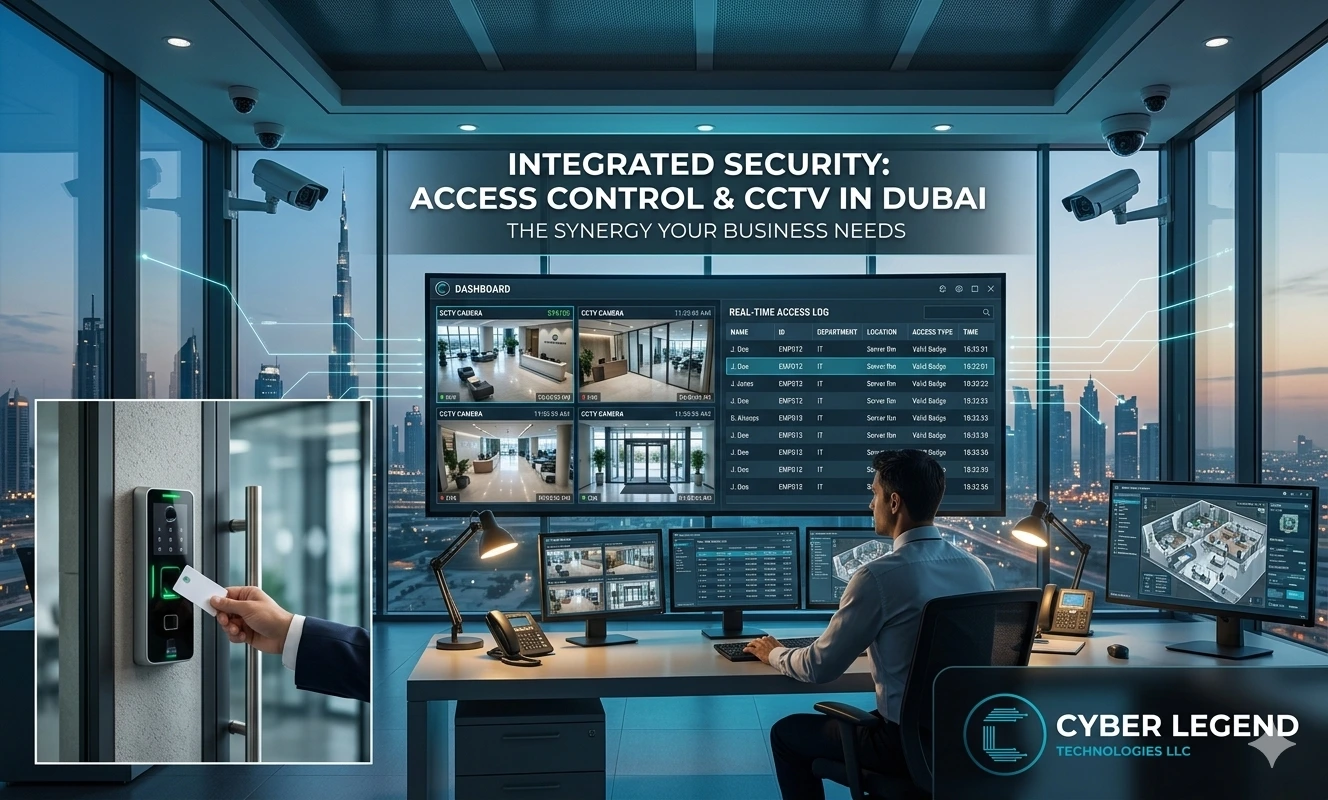
Access Control System and CCTV for a Business in Dubai: Do You Need Both?
Most Dubai businesses set up a CCTV system and consider their security sorted. Some install access control and assume that covers everything. Very few start with a clear understanding of what each system actually does — and why the two are not interchangeable.
CCTV and access control solve different problems. One records what happens. The other determines who is allowed in. Used separately, each has a blind spot. Used together, they create a complete physical security layer for any commercial premises in Dubai.
This guide explains both systems clearly, where they differ, and how to decide what your business actually needs — whether you are setting up your first Dubai office or managing multiple restricted zones.
What Are CCTV and Access Control Systems?
These are two separate systems that serve two different security functions.
CCTV — what it does:
-
Captures and records video footage across your premises
-
Monitors entry points, lobbies, car parks, and open areas
-
Stores footage locally or in the cloud for review
- Deters visible criminal activity
-
Cannot stop an unauthorised person from entering
Access Control — what it does:
-
Restricts entry to specific doors and zones using cards, PINs, or biometrics
-
Logs every entry attempt with a timestamp and user identity
-
Sends alerts on forced entry or failed access attempts
-
Allows instant revocation when an employee leaves
-
Cannot show you what happened inside a space after entry
The simplest way to separate them: CCTV answers "what happened?" Access control answers "who was allowed in?"
CCTV vs Access Control — What Each System Covers
| Function | CCTV | Access Control |
|---|---|---|
| Records who entered a space | ✅ Visually | ✅ Digitally logged |
| Prevents unauthorised entry | ❌ | ✅ |
| Provides real-time entry alerts | Limited | ✅ |
| Supplies visual evidence after incidents | ✅ | ❌ |
| Monitors open and public areas | ✅ | ❌ |
| Manages multi-zone access permissions | ❌ | ✅ |
| Instant credential revocation | ❌ | ✅ |
| Deters visible criminal activity | ✅ | Limited |
Neither system is a substitute for the other. They cover different parts of the same security requirement.
Do Dubai Businesses Need Both ?
Yes — for most commercial settings, both systems are necessary.
CCTV gives you visual evidence. Access control gives you a digital entry log. Together, they create a verifiable audit trail that is difficult to challenge — whether for an insurance claim, an internal investigation, or a compliance review.
Without CCTV, your access log tells you a key card was used — but not what the person did after entering, or whether someone followed them in.
Without access control, your CCTV footage shows you who was on camera — but could not stop them entering a restricted area in the first place.
The two systems answer different questions. A business relying on only one is operating with a partial security picture.
What About SIRA Compliance for CCTV in Dubai?
SIRA — the Security Industry Regulatory Agency — is the Dubai government body that oversees physical security systems, including CCTV installations across commercial premises.
Commercial buildings in Dubai are generally required to have CCTV installed by SIRA-approved companies. This applies to a wide range of business types including offices, retail outlets, warehouses, and hospitality venues.
What this means for your business:
-
Confirm your CCTV installer holds a valid SIRA approval
-
Ask your supplier for documentation before work begins
-
Check with your building management if your premises falls under specific SIRA coverage requirements
This is not something to assume — it is something to verify with your supplier before purchasing. Non-compliant installations can create liability and may need to be redone at additional cost.
Access control systems are not currently regulated under SIRA in the same way — but they are often specified as a requirement in commercial lease agreements and building management rules across Dubai.
Which System Should a Dubai SME Install First?
For most small and medium businesses, the practical answer is CCTV first — then access control as restricted zones are established.
CCTV provides broader initial coverage at a lower entry cost. It secures your perimeter, reception, and common areas from day one.
Access control systems becomes the priority when you have zones that require individual management:
-
A server room or IT cabinet with business-critical equipment
-
A finance or HR office handling sensitive records
-
A storage area with high-value stock or restricted materials
-
A reception-to-back-office boundary in a healthcare or legal setting
The trigger for adding access control is not company size — it is the existence of a space where not everyone should have entry.
Many Dubai SMEs phase this across 6 to 12 months: CCTV installed at setup, access control added once restricted zones are clearly defined. This keeps budgeting manageable without compromising the overall security architecture.
What to Ask Before Buying an Integrated Security System in Dubai
Before approaching any supplier for an access control system and CCTV for your business in Dubai, have answers ready for these five questions:
1. How many access points need to be controlled? Count all external entry doors, server rooms, storage areas, and executive zones separately. Each controlled door is a separate hardware cost.
2. Are the CCTV and access control systems compatible? Ask whether both systems support ONVIF — a standard that allows devices from different brands to communicate with each other. Incompatible systems cannot be integrated without significant rework later.
3. Do you need remote management? Both IP CCTV and cloud-connected access control platforms support remote access via mobile. Confirm this is included — not an add-on cost.
4. What is your footage retention requirement? Most Dubai commercial premises retain CCTV footage for a minimum of 30 days. Some industries and building agreements require longer. Confirm this before specifying your storage capacity.
5. What after-sales support is included? Ask specifically about response times for hardware failure, firmware updates, and on-site maintenance. Security systems that go offline without quick support leave your premises exposed.
FAQs
What are the best access control systems compatible with CCTV for businesses in Dubai?
Systems that support ONVIF — the interoperability standard for IP security devices — integrate most reliably with IP CCTV cameras across major brands. Look for access control platforms that offer a unified dashboard or API integration with your camera management software.
Brands commonly deployed in Dubai commercial settings include ZKTeco, Suprema, and HID — but compatibility should always be confirmed with your specific CCTV setup before purchasing.
Which companies offer integrated access control and CCTV solutions in Dubai?
Several IT and security suppliers in Dubai offer both systems as a combined solution. When evaluating suppliers, check for:
-
SIRA approval for CCTV installation
-
Experience with your premises type — office, warehouse, or retail
-
Post-installation support and AMC (Annual Maintenance Contract) options
-
Ability to supply and integrate both systems under one contract
A single supplier managing both systems reduces compatibility risk and simplifies ongoing maintenance.
Are there affordable access control and CCTV packages for small businesses in Dubai?
Yes — entry-level packages exist for both systems, and costs have come down significantly with the wider adoption of IP-based security technology. For small businesses, a practical starting point is:
-
4 to 8 IP cameras covering entry points and key internal areas
-
A basic access control reader on 1 to 2 restricted doors
-
Local NVR (Network Video Recorder — a device that stores camera footage on-site) storage for CCTV footage
A phased approach — CCTV now, access control when needed — keeps initial investment manageable without locking you into a system that cannot scale.
Does Dubai law require businesses to install CCTV?
Dubai does not have a single universal law mandating CCTV for all businesses. However, many commercial premises are required to install CCTV under building management rules, free zone regulations, or sector-specific requirements.
SIRA-approved installation is the standard for commercial CCTV in Dubai. If your premises falls under a SIRA-regulated zone or building, non-compliant systems may not be accepted. Always confirm your obligations with your building management and a SIRA-approved supplier before installation.
Can access control and CCTV be managed from one dashboard?
Yes — when both systems are compatible. Integrated platforms allow you to view camera feeds, review entry logs, and respond to alerts from a single interface. This requires both systems to either share a common software environment or support API integration.
Confirm this capability with your supplier before purchasing. Retrofitting integration after the fact adds cost and complexity that is easily avoided at the buying stage.
Conclusion
CCTV and access control are not competing investments — they are complementary layers of a complete security strategy.
CCTV covers what you can see. Access control covers who gets in. For Dubai businesses managing restricted zones, high-value assets, or regulated environments, deploying both is the professional standard — not an optional upgrade.
The right combination depends on your premises layout, the number of restricted zones you manage, and your integration requirements. A qualified IT and security supplier in Dubai will assess your site and recommend a scalable solution that fits your current needs and grows with your business.
Explore Cyberlegend's range of CCTV cameras and access control systems in Dubai — or speak to our team as your trusted IT supplier in Dubai for a combined security assessment.